Instagram's artificial "intelligence" discriminates between posts on the basis of the symbols they contain; it recently happened to a post showing one of my paintings.
The paradox is that the post that was hidden (censored) was meant as a reflection on the role of the media in recent history and on their ability to manipulate the truth in favour of power.
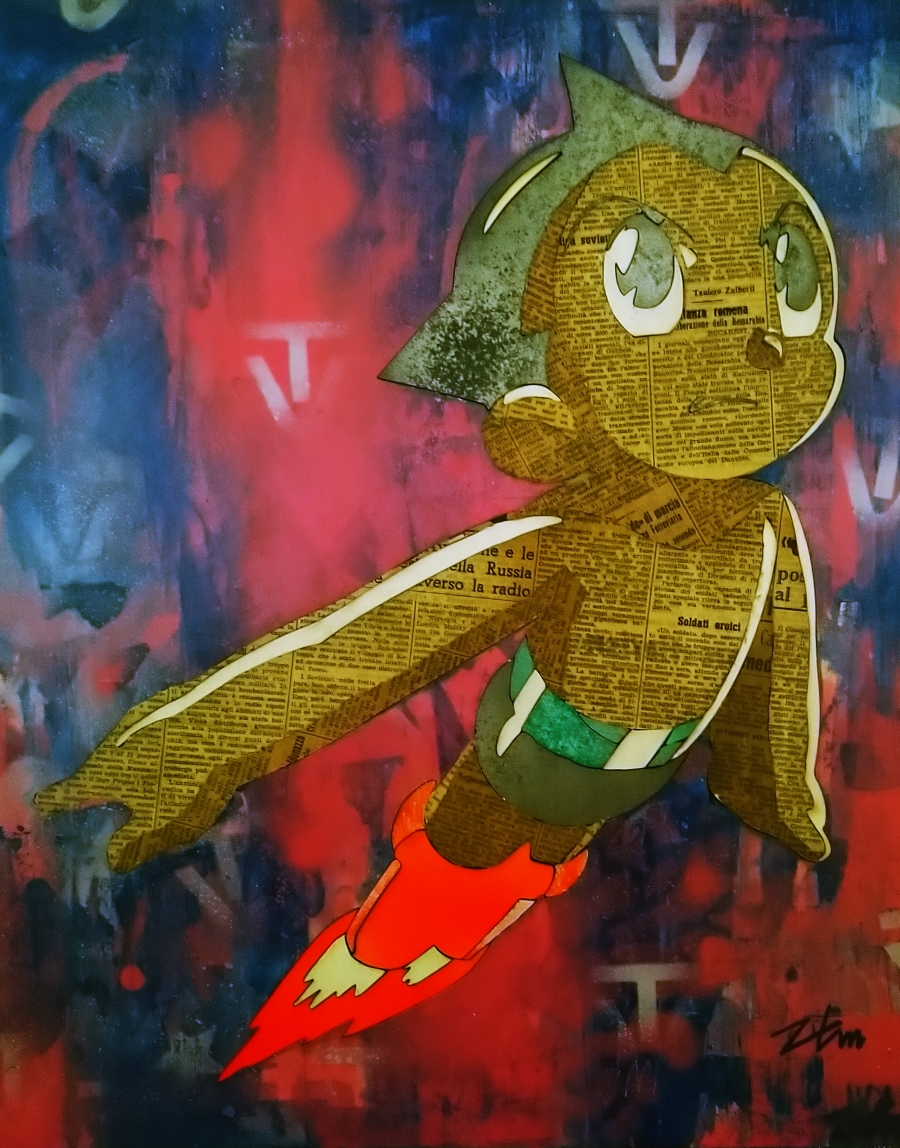
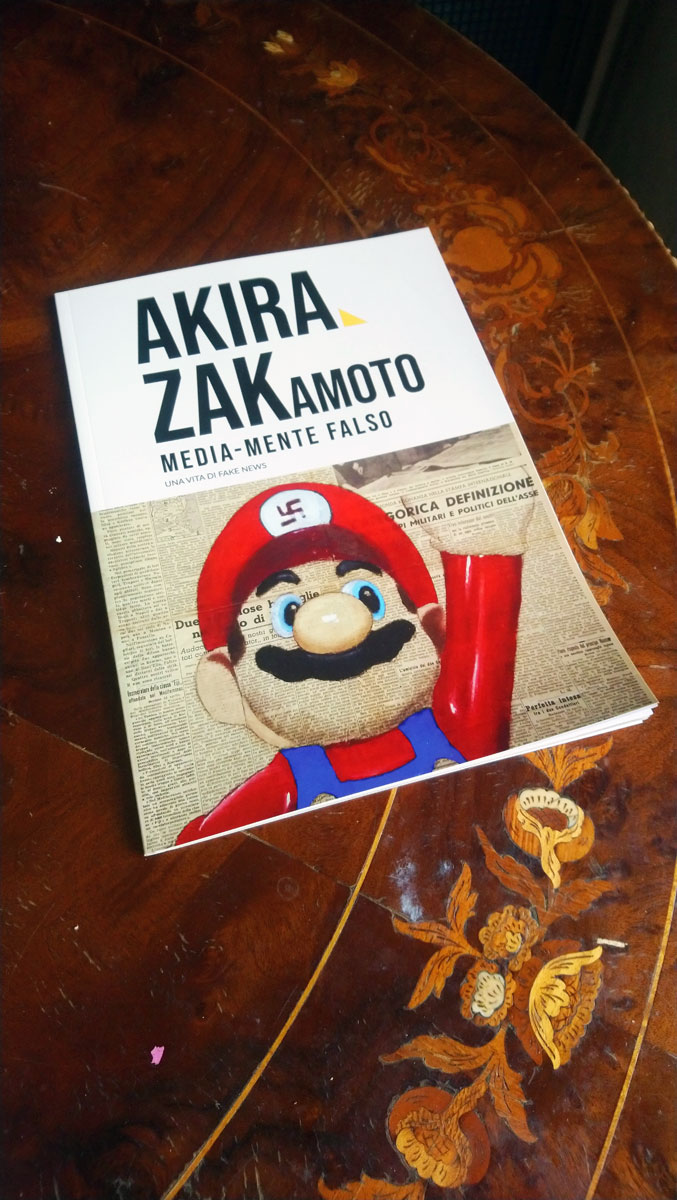
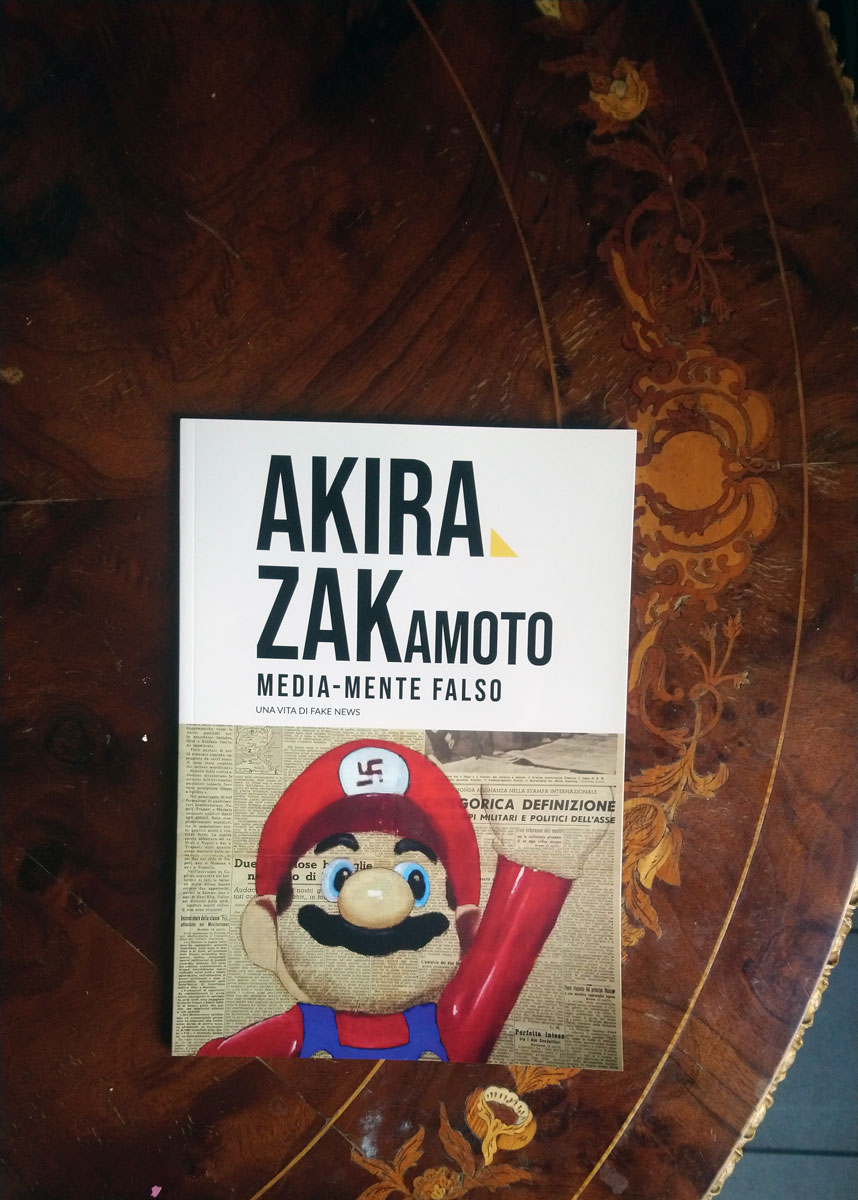
The work depicted Toei's Super Mario character wearing a Nazi cap, painted in oil on an original page of the Corriere della Sera of 13 April 1945.
At that point in history Italy had surrendered to the Allies two years earlier, yet our leading daily ran the headline: "Iron will to fight on to victory", next to a photograph of Hitler and Mussolini planning their military moves on a map.
The articles on the page recount a reality of hyperbolic fantasy, in which it is taken for granted that the fascists, together with their German ally, will shortly win the war in Italy and in the colonies.
In the excellent series set in a reality parallel to ours, "The Man in the High Castle", directed by David Semel (Amazon Prime Video), the Axis has won the war and Germany and Japan have divided up the world; the Italian fascists are not mentioned in any of the forty episodes. So the Corriere headline of '45 finds no support even in a work of dystopian fiction eighty years later.
In reality, on 13 April 1945 the Germans were losing Vienna to Stalin's troops; twelve days later Italy would be liberated by the Americans, and fifteen days later Mussolini would be executed by the partisans.
The editor of the Corriere, Ermanno Amicucci, chose in those days to manipulate reality because power was still in the hands of the Nazis (who had occupied Milan) and of the Fascists of the Italian Social Republic.
Today, even more than in '45, the one power that moves all the others is economic. For this reason the internet is no longer the place of free expression and free circulation of information that we helped to build at the start of the millennium: the economic kraken has seized our toy and turned it into a money machine.
Instagram and the other social networks are no exception: they are not there for meeting people, sharing or communicating, but for creating a market.
Censorship in this context is carried out by anonymous artificial "intelligences", with the aim of favouring transactions and the consequent creation of economic value.
The attempt is to reduce as far as possible controversial material, discrimination, alternative information, violence and so on, so as to create a space that is as inclusive as possible, in which one may buy and sell in complete trust and safety; culture and art are therefore expected to bend to this imperative.
One sells better by entertaining, by talking about trifles, by keeping the level of the narrative comprehensible to everyone. This is why most of the posts we see tell of tragicomic accidents, seductive women and, naturally, products purchasable with a single tap of the finger.
Anyone born in Italy in the seventies, as the present writer was, remembers - among the various pieces of rubbish we have witnessed - the birth of private television, in which for the first time stupidity, trifles and large breasts were the dominant theme of most programmes. Advertising revenue worked so well with these themes that RAI had to bow to the evidence, so much so that today there is no difference between the two broadcasters apart from the licence fee.
One might say that Berlusconi was the first to understand this, and therefore the best from an entrepreneurial point of view, consequently the richest, and later also the most voted for.
President of the Council of Ministers of the Italian Republic, tipped to become President of the Republic - if only he had realised that the electorate adores trifles and large breasts, and tolerates prostitutes, but does not forgive whoremongers.
In the newspapers of yesterday and the day before you find the future as it was seen and hoped for in the past, and the past that never came about in the future; the lie elevated into a frame of reference; lying in order to persuade and to incite; and above all war, the one constant of these last eighty years of peace.
History has always been written by the victors, by political and military power.
Today the past, history, the present and the idea of the future are written through the technological and media power to mystify reality, to gratify the ego of the recipients of a message, until they are brought to believe that the surrogate of reality they are looking at is reality itself.
Recourse to the surrogate is increasingly present in every aspect of human life, and is experienced by most people as something innovative, ecological, emancipating, healthy, improving, safe.
Pets, robots and silicone dolls are used as surrogates for children, husbands, wives, lovers and grandchildren; plastic surgery is used to produce surrogate bodies and sexual identities; pornography and safe sex allow the sexual act itself to be surrogated; synthetic foods, vegan foods, nutrition bars, the medicines that allow performance to be enhanced in every field - human beings themselves are surrogates of themselves.
Towards the most intimate and fundamental spaces of our existence, products, ideas and behaviours are promoted that seek to draw us away from real life and towards a fictitious, virtual, synthetic life, in which inner experience is replaced by the mystified image society has of us.
A lie repeated endlessly does not become true, but it does make mystification a socially acceptable practice; the sense of the true is lost behind the awareness that every truth might contain, in whole or in part, a mystification.
In this context the ablest and most generous person can appear too good to be true, and the most despicable person can appear sanctified by invented truths.
By agreeing to delegate to the technological and media system the power to define truth, we agree to live in a vortex of information produced to sustain one mystification rather than another.
The pandemonium caused by the coronavirus made the idea of a surrogate, masked life-experience more appealing - one in which we seek the recognition of the group without having to meet individuals.
The history of our own days will again be written by the victors of a war made of lies, but the technological capacities we have arrived at will allow us to create mystifications on a scale never seen before.
We lie to ourselves, and every day it is harder to catch ourselves doing it; the surrogate life devours the real one.
Introduction to the catalogue of the MEDIAMENTE FALSO project.

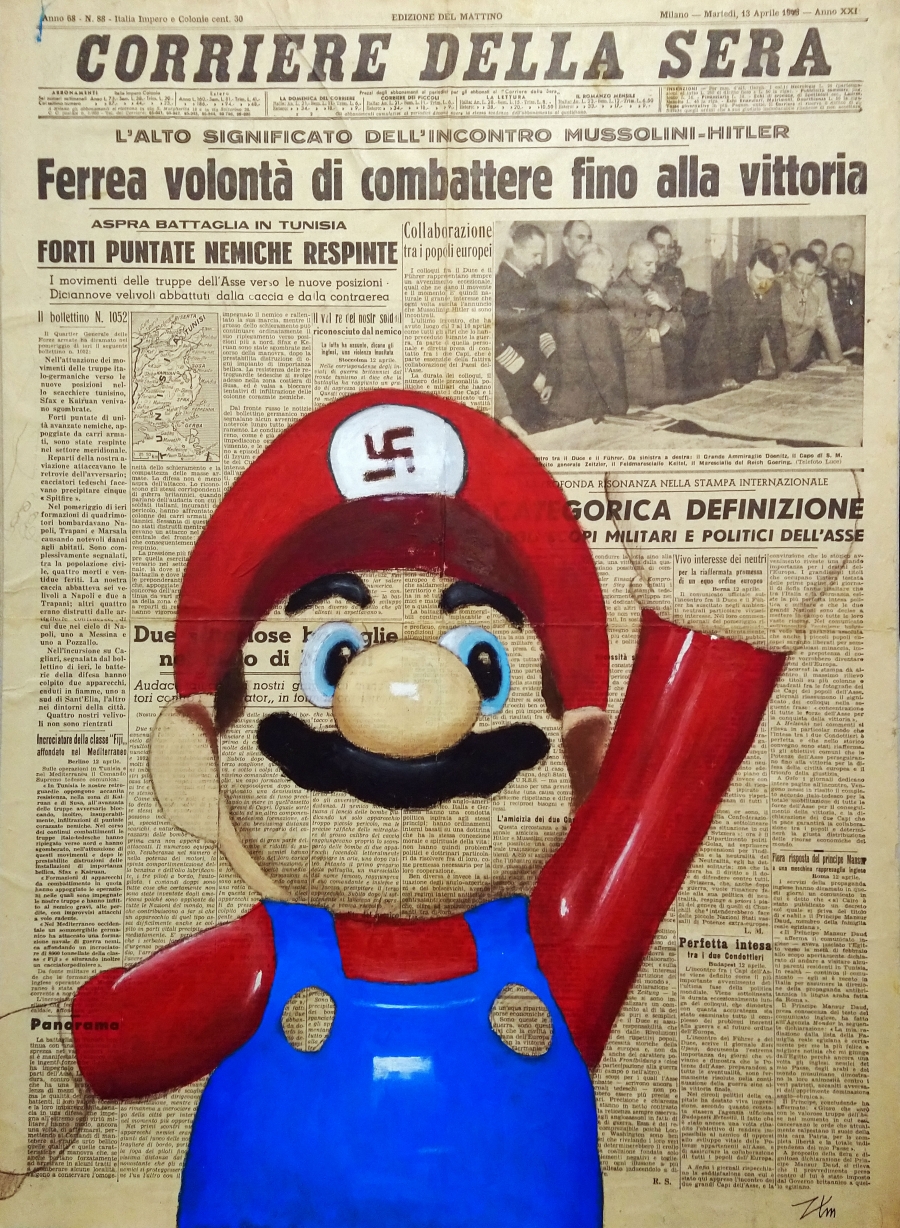 CORRIERE DELLA SERA 13-04-1945 - Oil on period newspaper - 45 x 60 cm.
 Painting - like related techniques of reproduction on the plane of two-dimensionality and of "low definition", such as graphic art, comics and advertising images - has currently become a privileged instrument of artistic expression.
Art in general has for some years now been considered a "fashionable" phenomenon.
This owes much to a euphoria that is largely artificial and determined, in my opinion, chiefly by the invasiveness - in some respects even beneficial - of a communications apparatus which, ever hungrier for subjects to debate and popularise, has lately discovered that art too holds a not inconsiderable niche of interest, particularly when it makes use of the rhetorical instruments of astonishment and sensationalism, as the shrewd marketing lesson of the new English art has amply taught.
This "return to painting" is the child of the weariness produced by the 1990s - in part perpetuated in the following decade as well - with their uninterrupted succession of neo-conceptual devices, banally citationist and sterile from a linguistic point of view.
In truth painting, after an evident absence from the scene lasting some years, due to the phenomenology of an art that had imposed the minimalist and analytical ardours of historical Conceptualism, returned in force after the mid-1970s: at first alone, and from the 1980s onwards, down to the present, in the company of other expressive modes that give body to contemporary artistic eclecticism.
The painterly medium is used to establish a relationship of evocation with the contemporary scene, sublimating the real in order to draw out its hidden humours, challenging photography and forcing it to adapt by chasing it onto its own ground.
What appears partly unprecedented and stimulating today is the readiness to mix, with ease, traces and visions belonging equally to "high" and to "low" culture.
Fragments of history mingle with psychedelic and metropolitan visions, together with symbols belonging to the traditional repertoire of pop art, as well as to fashion, illustration and comics, creating a balanced miscellany that seems to revive the glories of the best years of the Eighties, when the rediscovery of individualism and the search for a satisfying aesthetic capable of contaminating genres came to the fore.
The relationship between "pure art" and "applied art" - over the course of the twentieth century often unbalanced in favour of the latter, ready to snatch linguistic innovations from the former in order to adapt them to mass culture - now seems to be placed on a level of perfect equilibrium, with the two spheres taking on the function of communicating vessels.
This vocation for a "total" art - traceable also in forms of graphic design that tend towards the creation of a language of their own, far from fashion, with an original grammar and vocabulary, so as to be able to communicate in a world already saturated with signs; in eco-sustainable design; in Street Art and in particular forms of metropolitan artistic craftsmanship - constitutes the most significant novelty of these last few years.
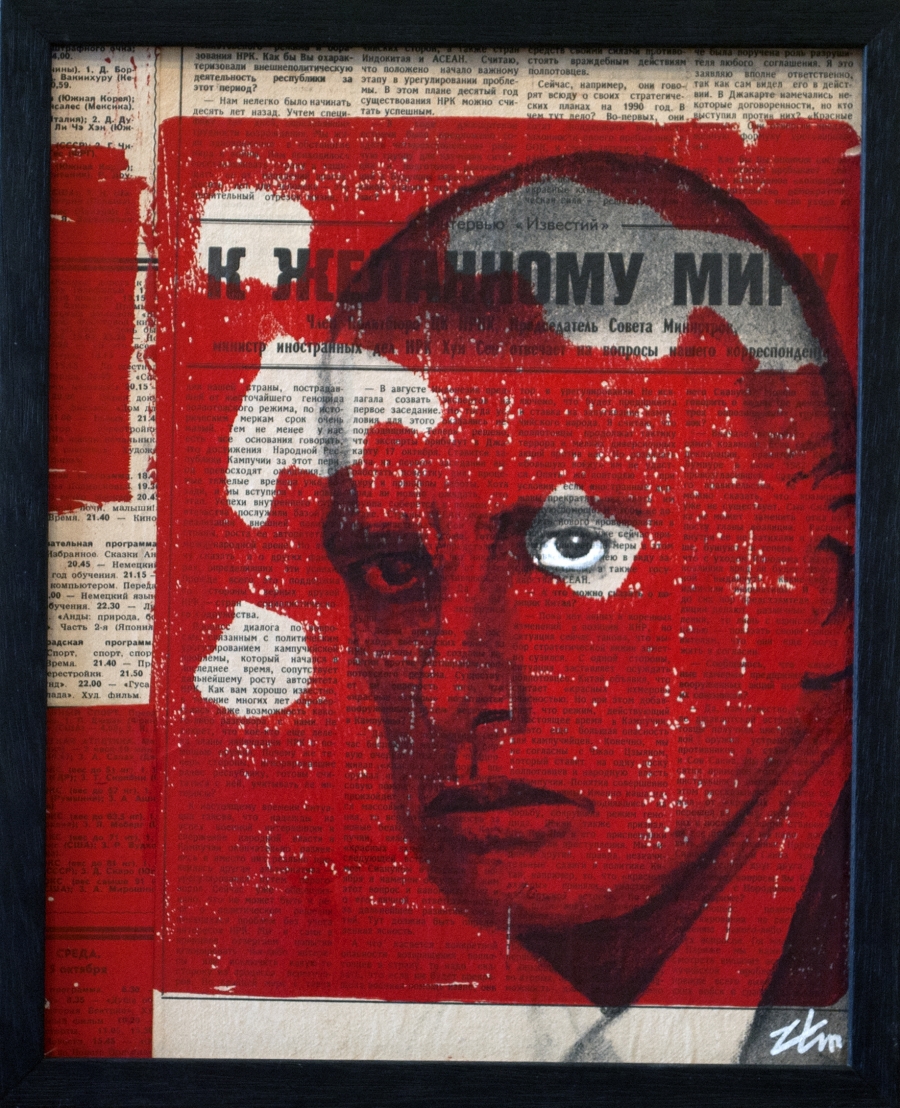
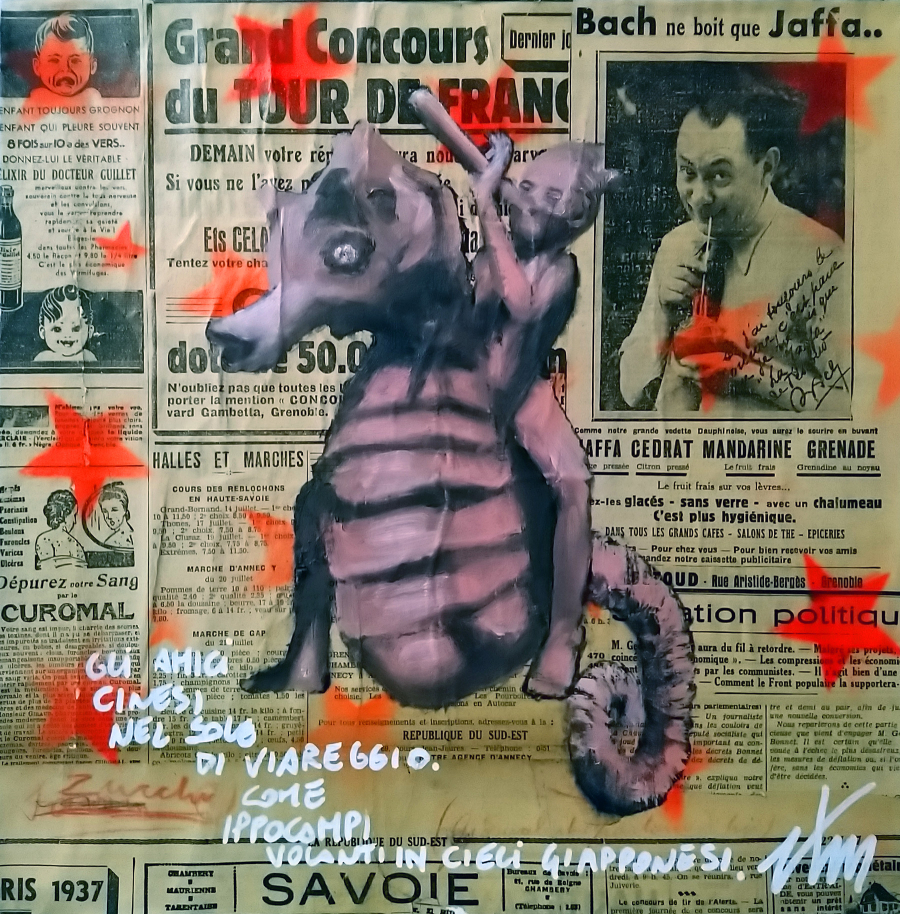
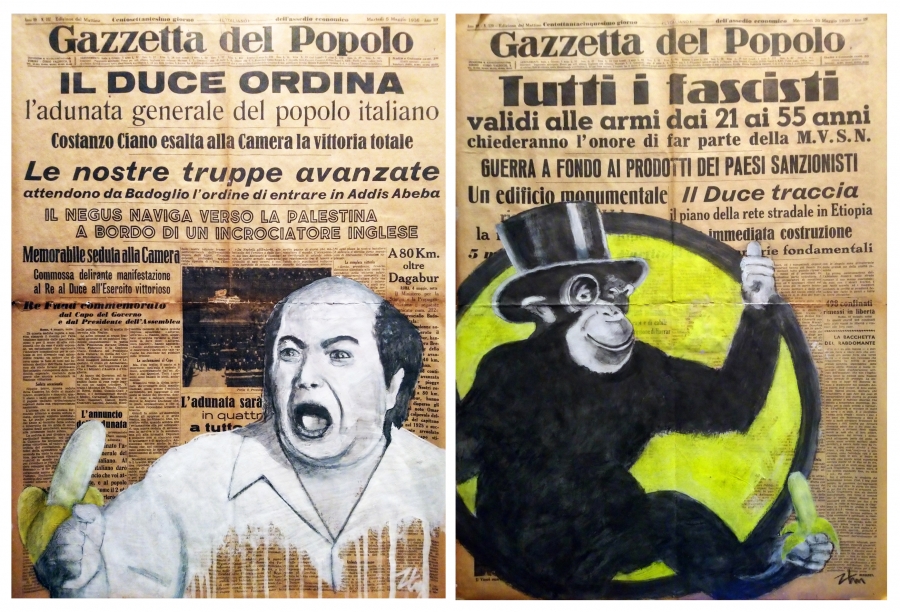
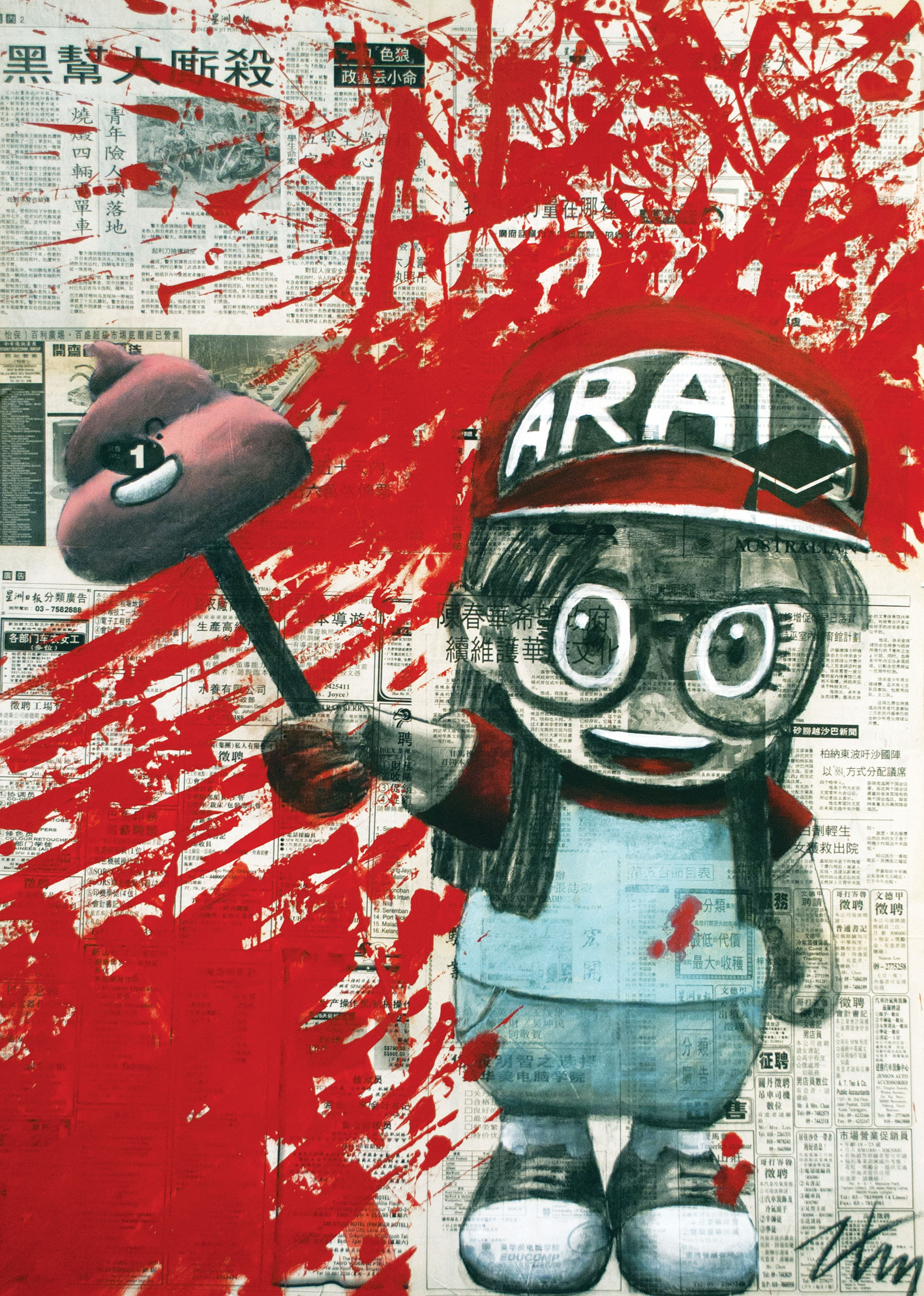
The work of Akira Zakamoto, which I culpably did not know, struck me favourably for its capacity to land hard blows on the hypocrisy of the society of spectacle and image that characterises our present dimension, employing signs, symbols, objects and "vintage" inserts. It belongs fully to the climate described above, to which it makes a contribution of considerable originality.
Zakamoto, whose registered name is Luca Motolese, has a background of study and profession bound up with advertising graphics, cinema and communication - all components traceable in that skilful miscellany of visual cues that are his compositions. These are almost always painted, with a knowing use of tonalities and chromatic scales, at times spilling over into three dimensions with the making of ironically votive works, always inspired by his ability to create temporal short circuits through the use of cuttings from the media imagination or from the childhood universe, and through the creation of sharp metaphors that speak of the contemporary world using symbols and icons of the recent past.
I examined Zakamoto's output with great interest: it is divided into series linked to one another by a precise ideological coherence, only apparently tempered by the aesthetic pleasantness of the composition.
To send effective messages there is no need to entrench oneself behind conceptual hermeticism; immediacy is an effective instrument, and didactically useful in creating an interest that then leads one to question the content of the representation.
In some canvases symbols of the childhood imagination predominate: retro games, decorative patterns that play on the thread of memory, creating a subtle metaphysical suspension.
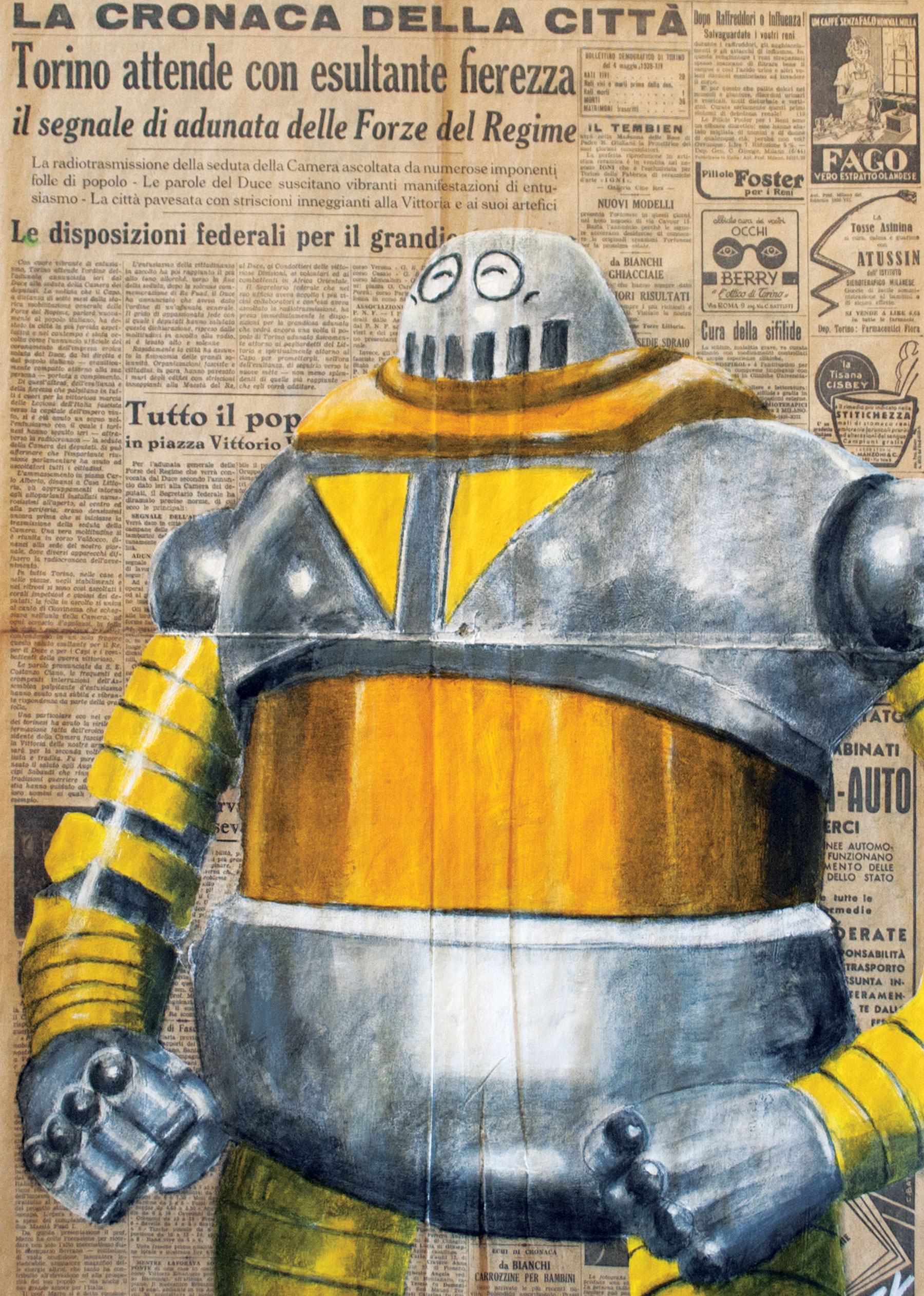
In others the protagonists come from the world of Japanese manga and of the super-hero robots who defend the world from the apocalypse, replicating the stoic self-denial and spirit of sacrifice of the samurai: icons drawn from the adolescent visions of the artist who, like many of his generation - and in part of mine too, fifteen years older - fell under the spell of Japan, seen as a land able to combine tradition with the future, discipline with an eccentric transgression.
The works selected for this solo show at the Galleria Spazio 44 - which confirms its characteristic habit of making original and non-conformist choices - are titled "Fake News", and constitute a reflection on the fallibility and distortion of communication through the media: substantially unchanged in time and space, and today amplified solely by virtue of technological progress and simultaneous communication via the web.
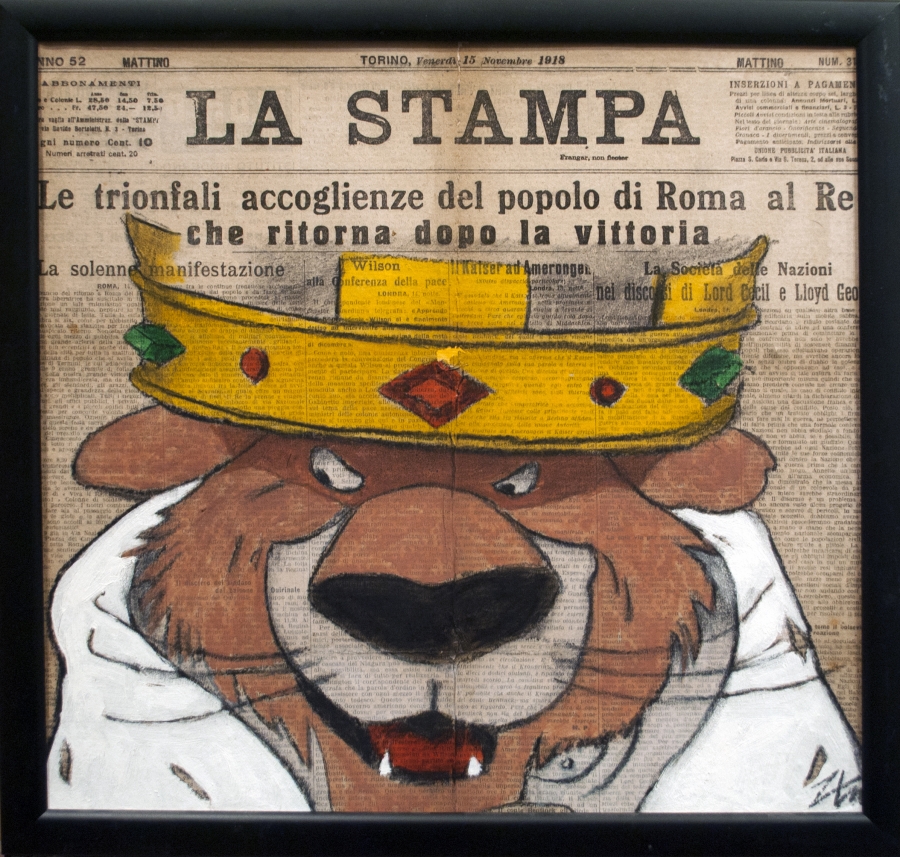
Drawing on his spirit as a collector of mid-century objects - a passion that in many ways we share, and his studio contains genuinely interesting and original finds from decades past - Zakamoto has tracked down, in second-hand markets and from private individuals, period front pages relating to some of the most significant events in the history of the twentieth century, the "short century".
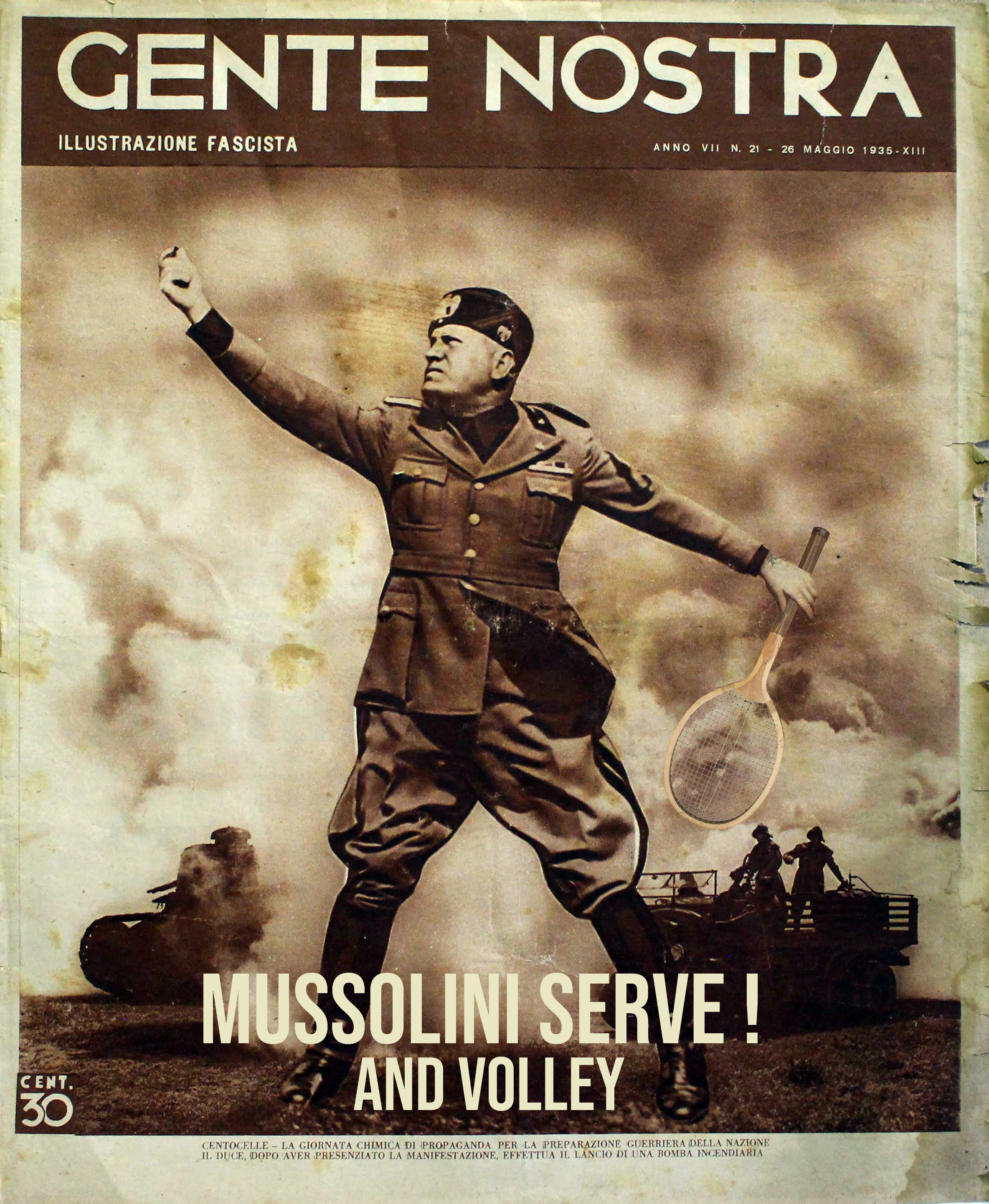
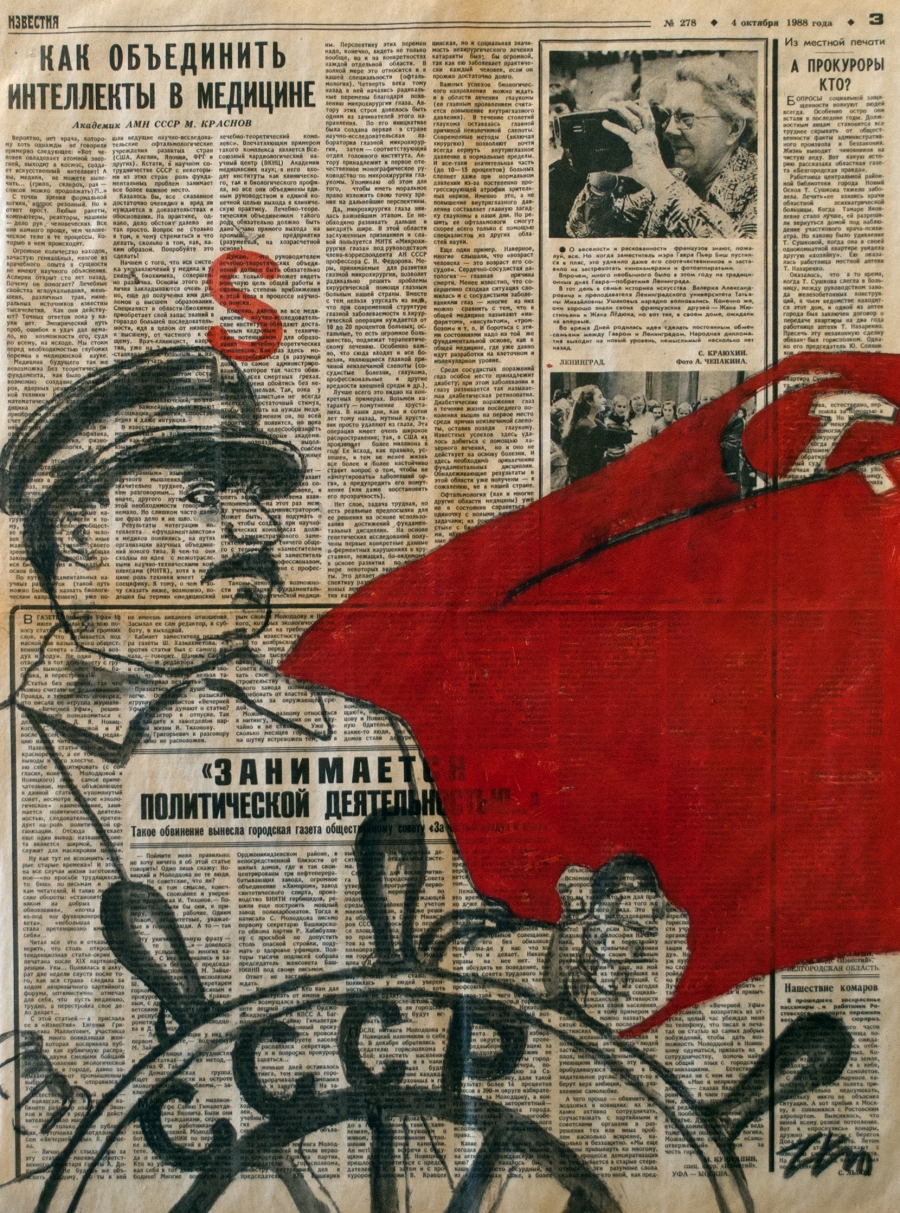
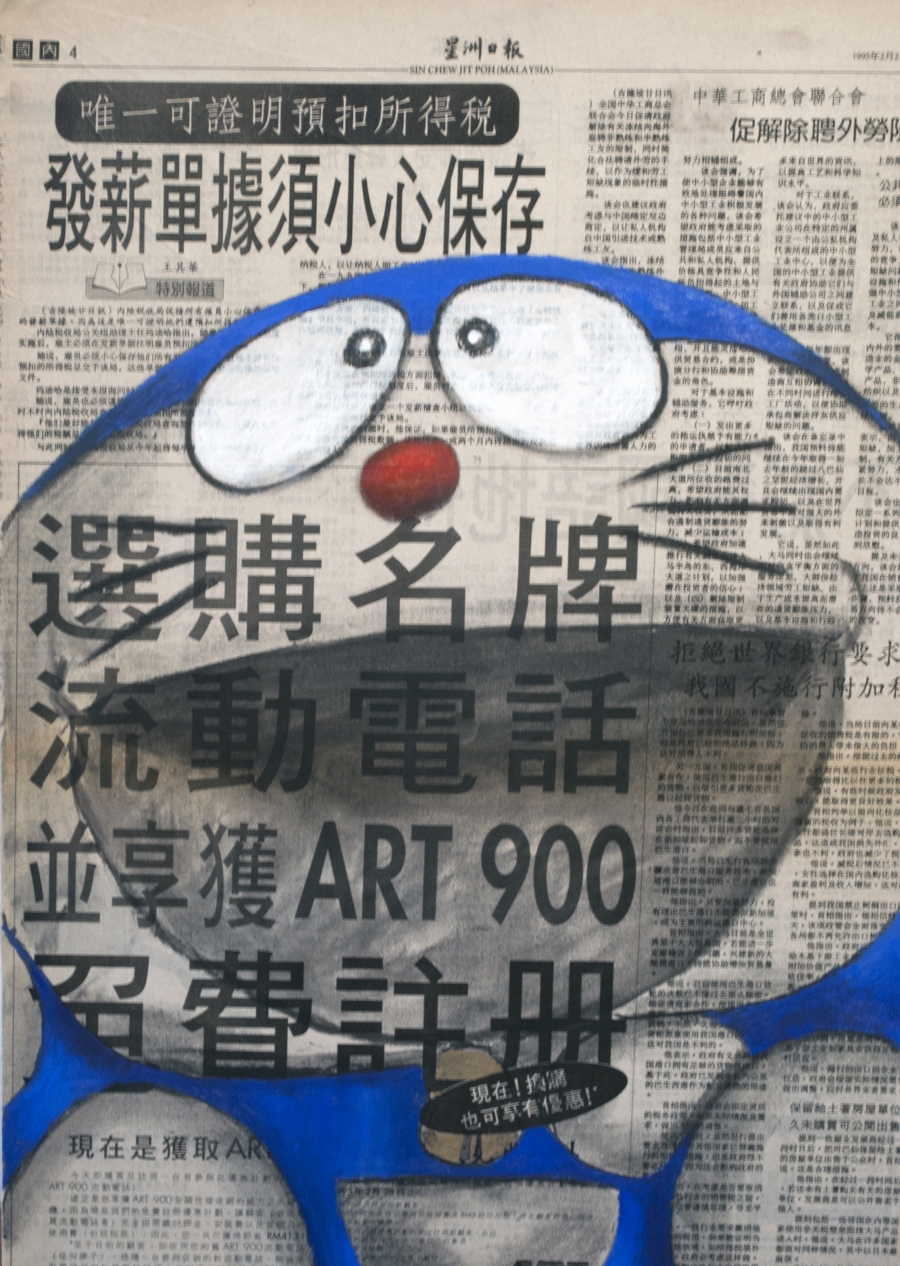
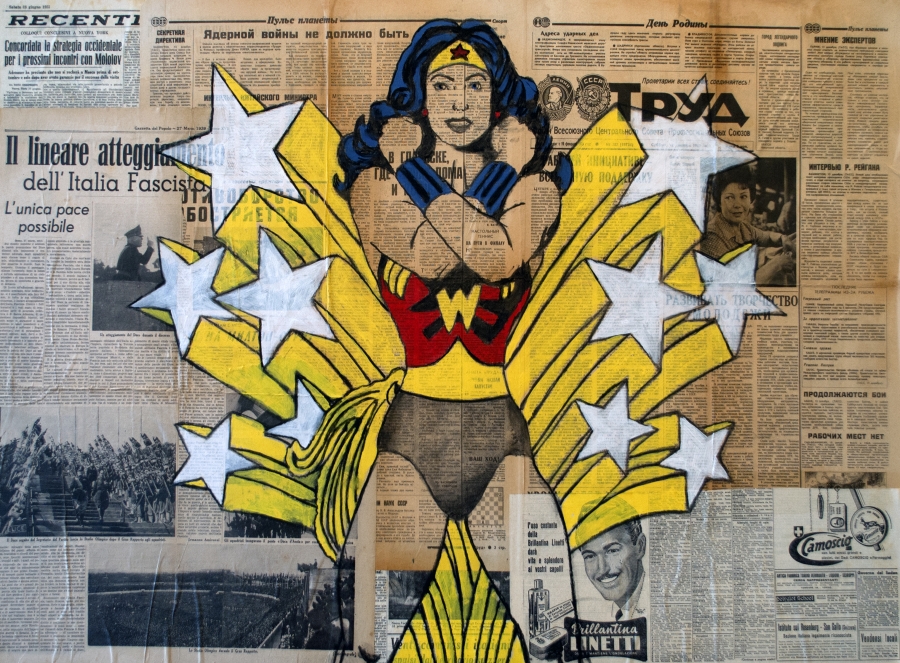
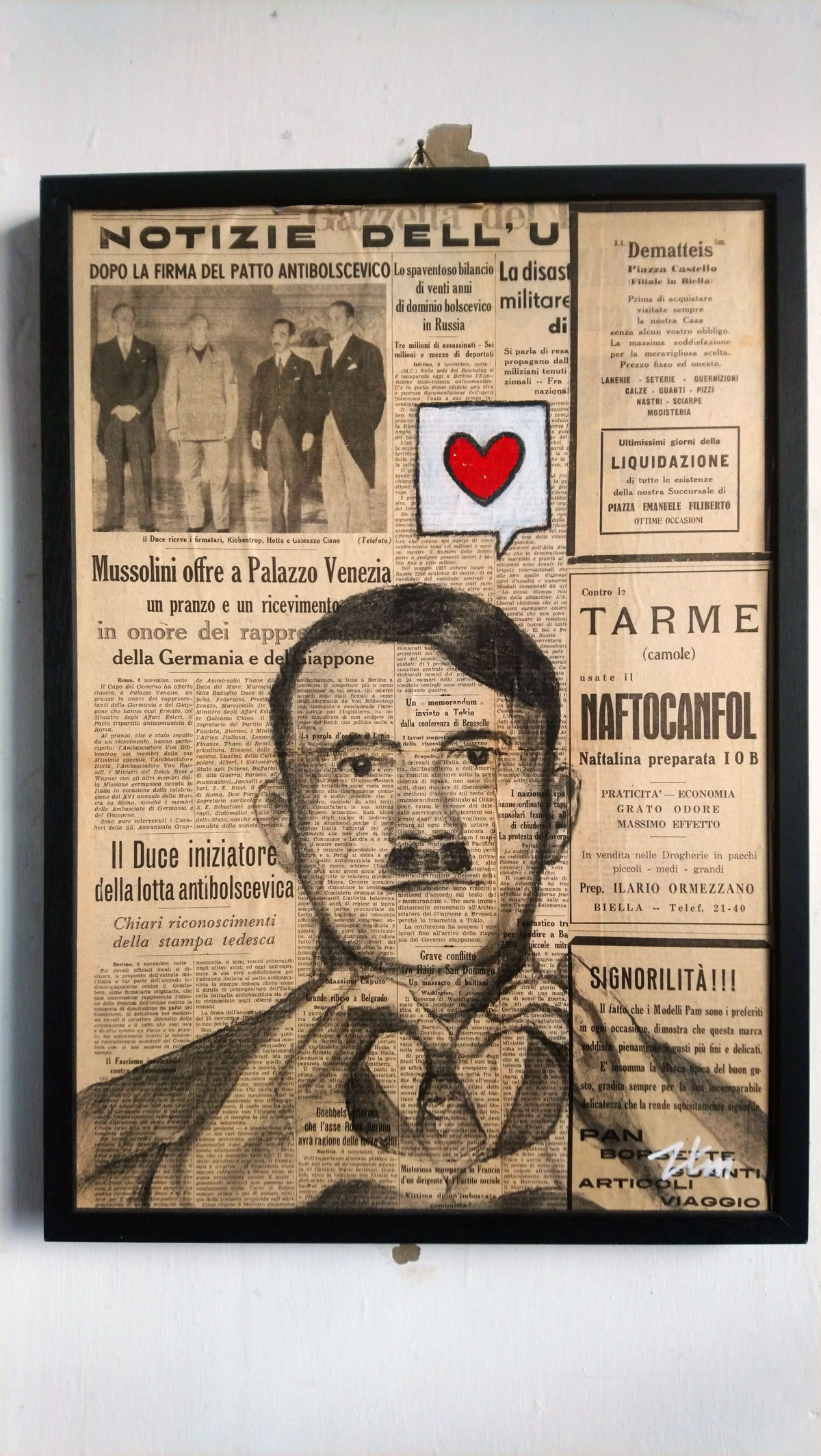
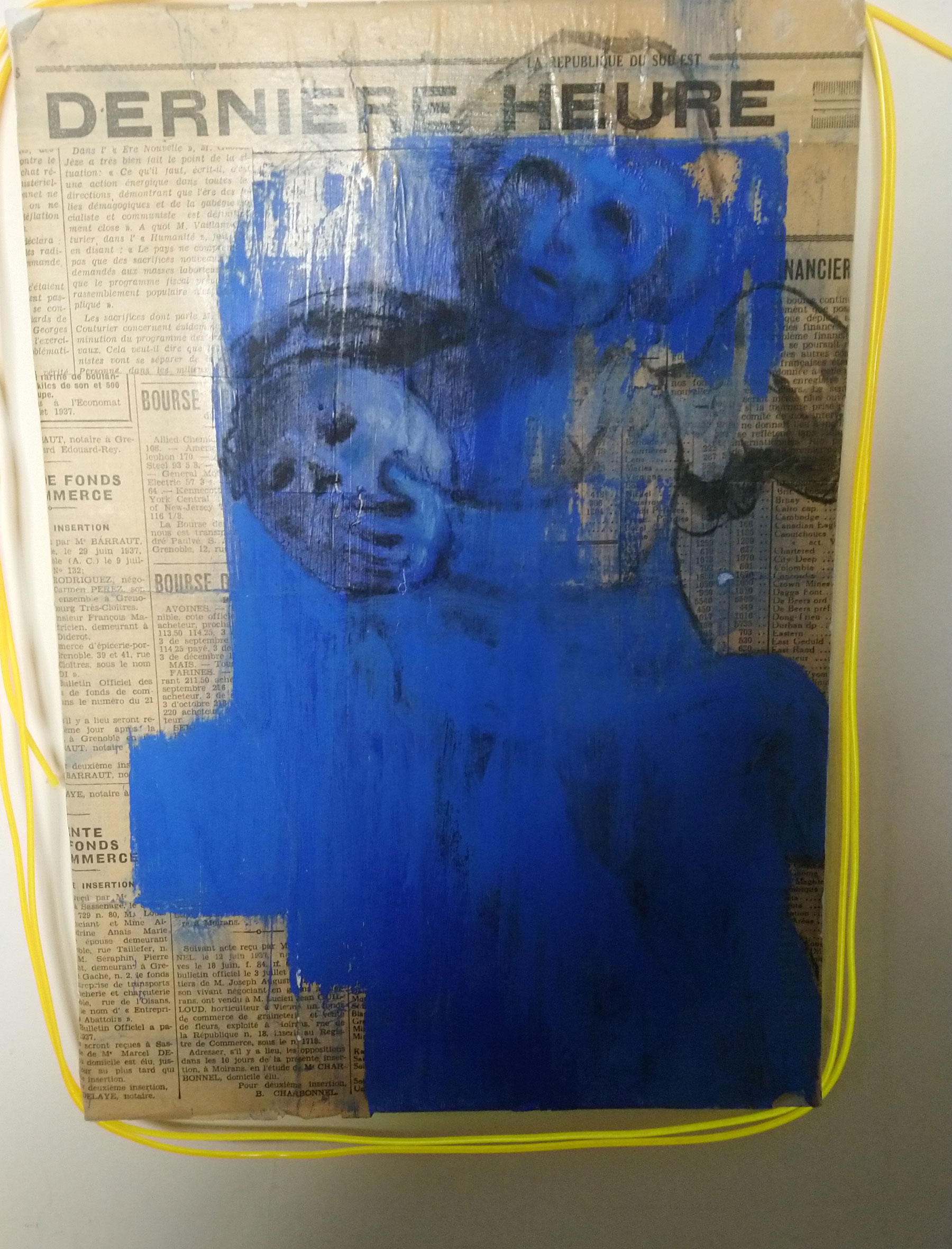
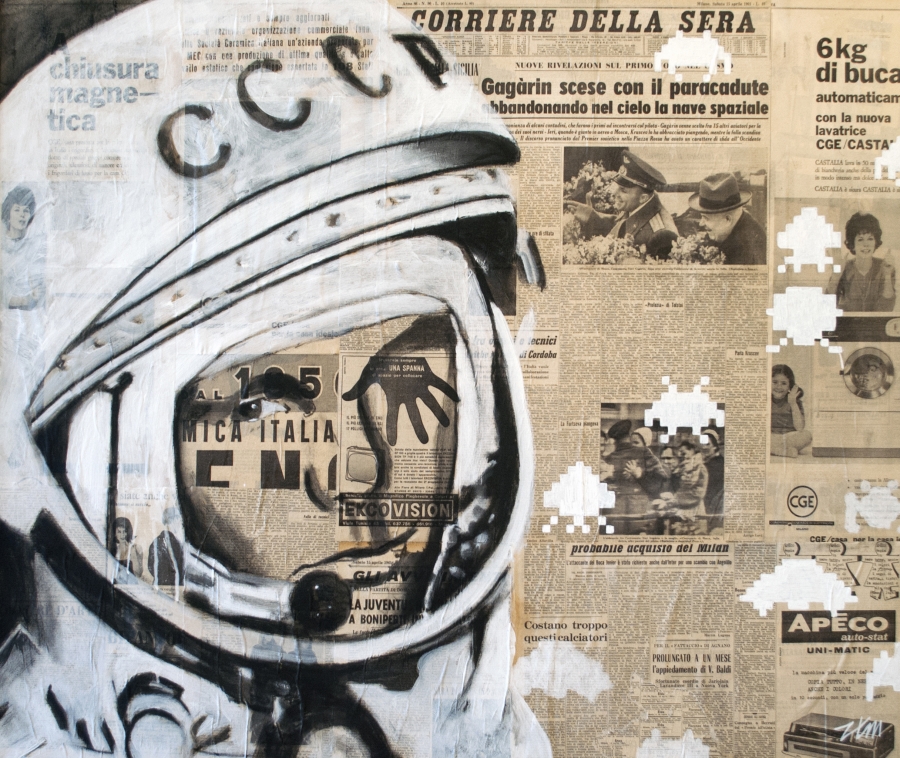
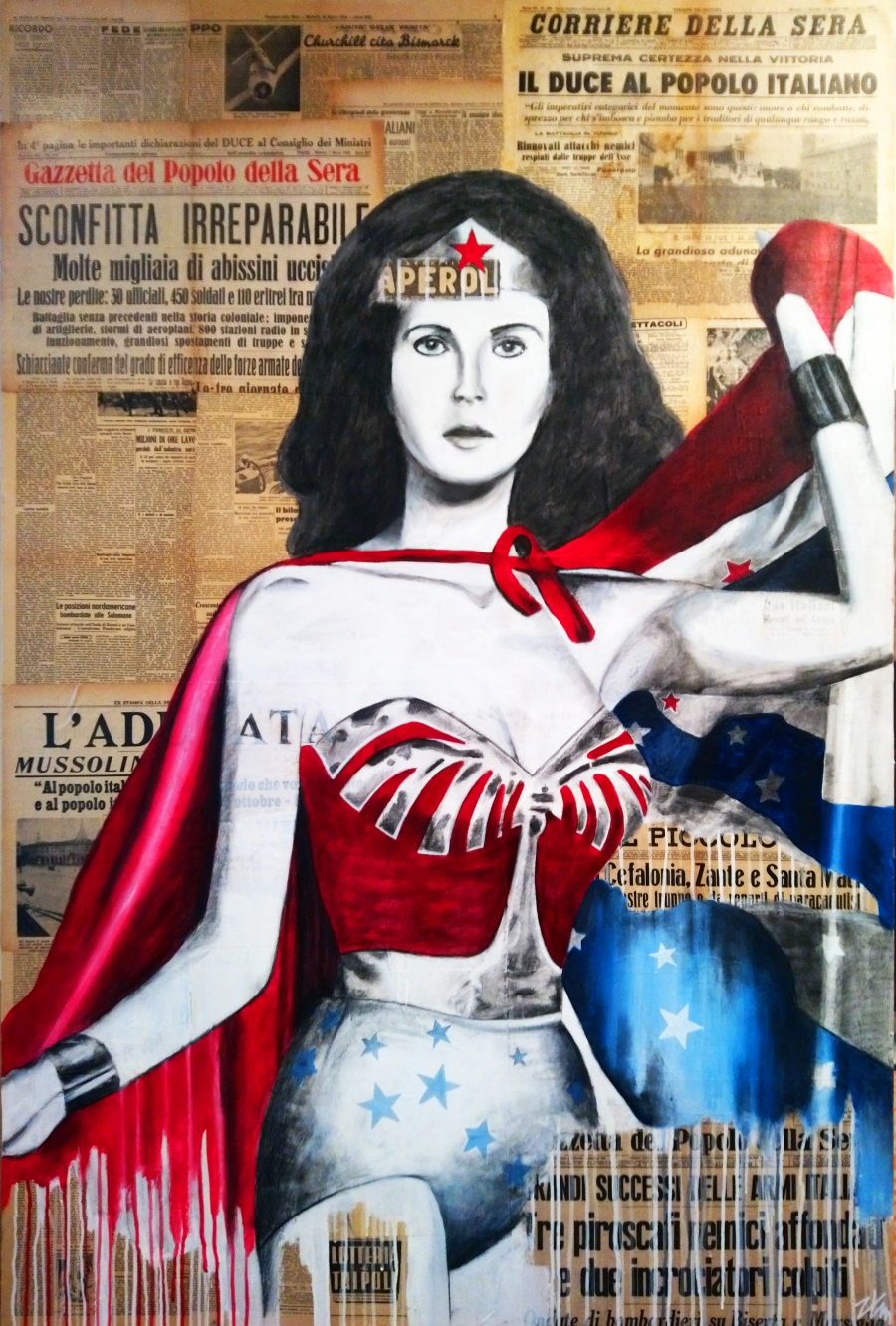
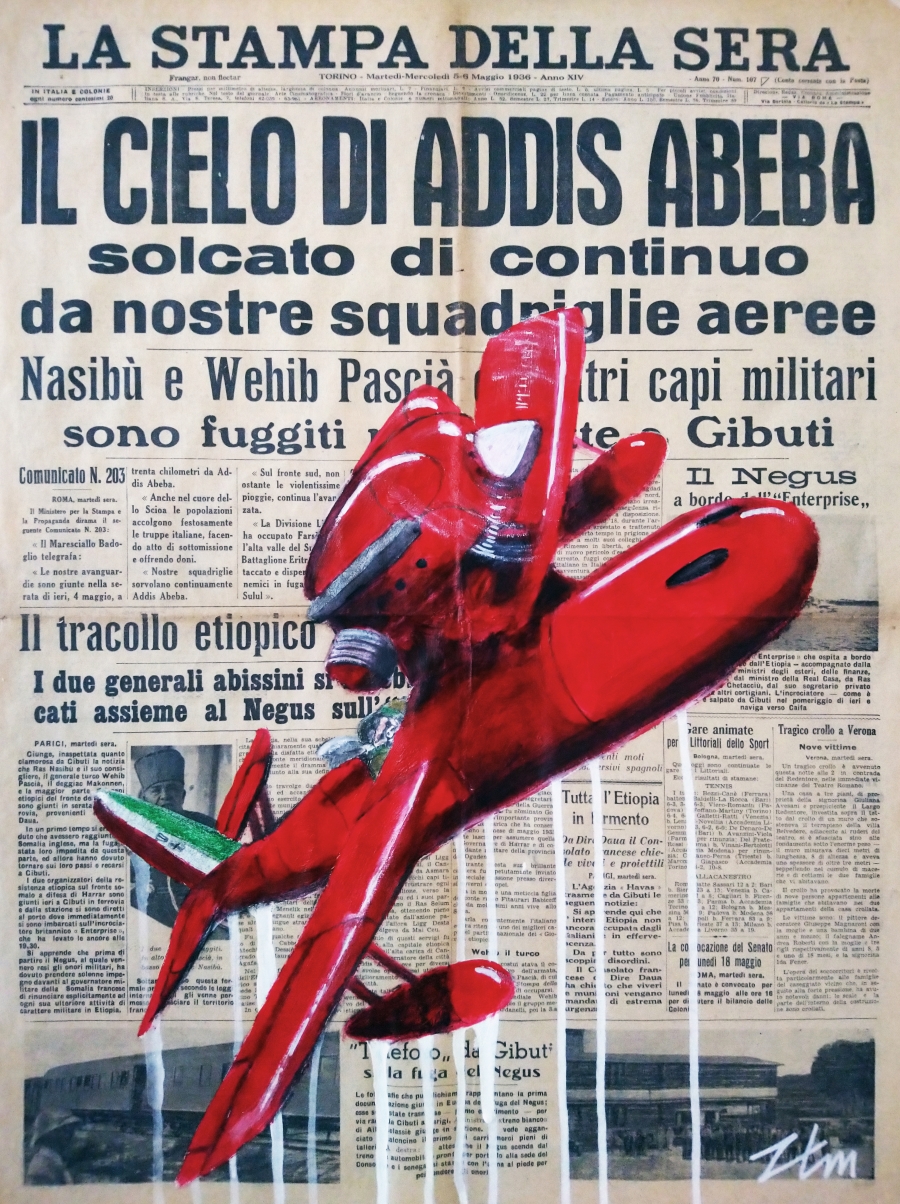
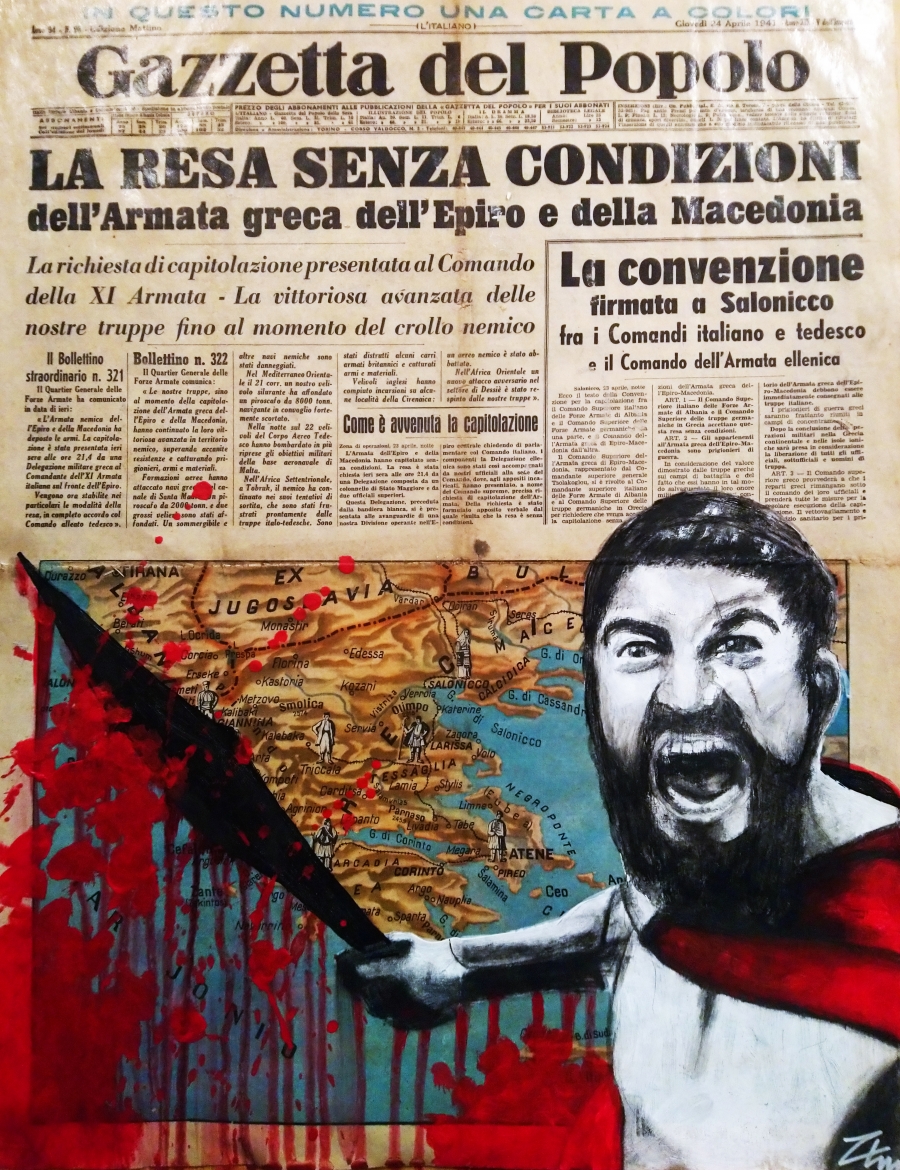
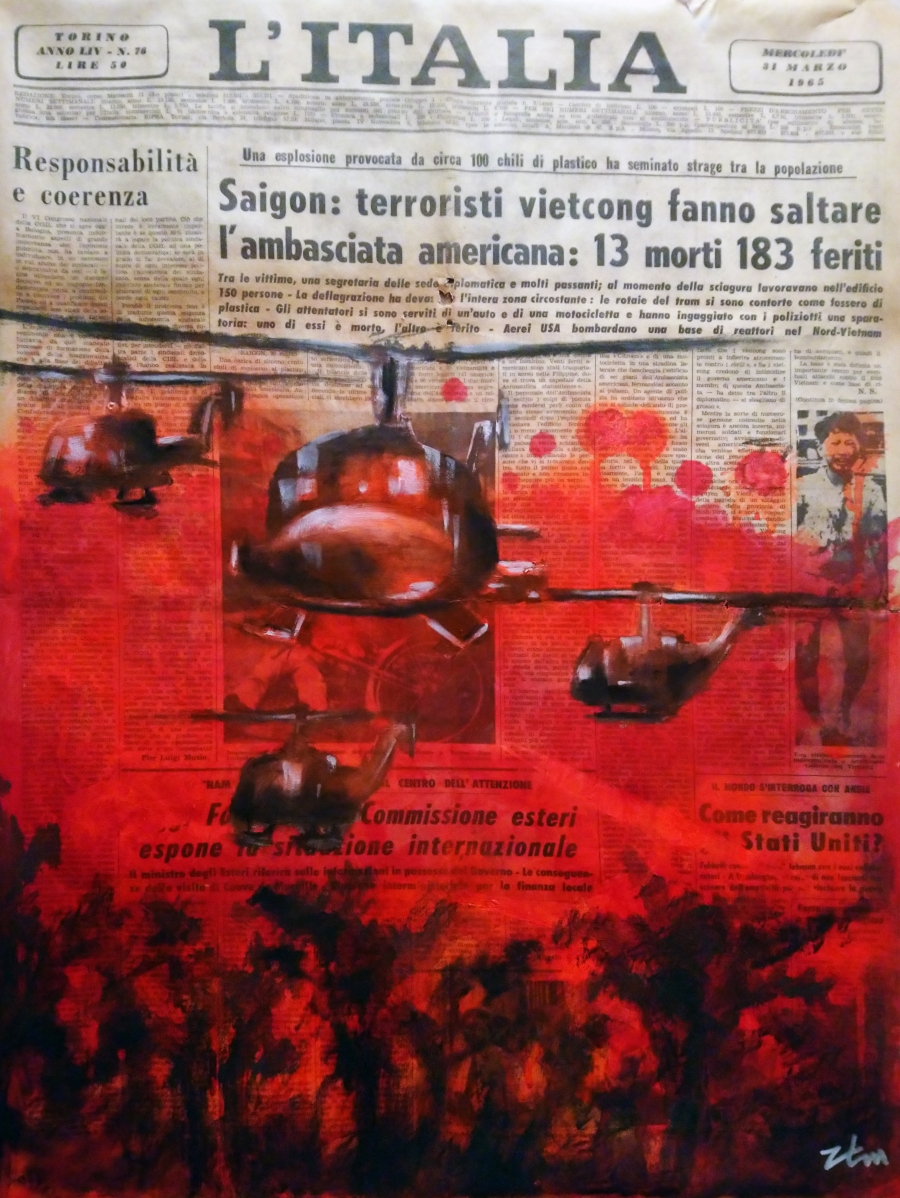
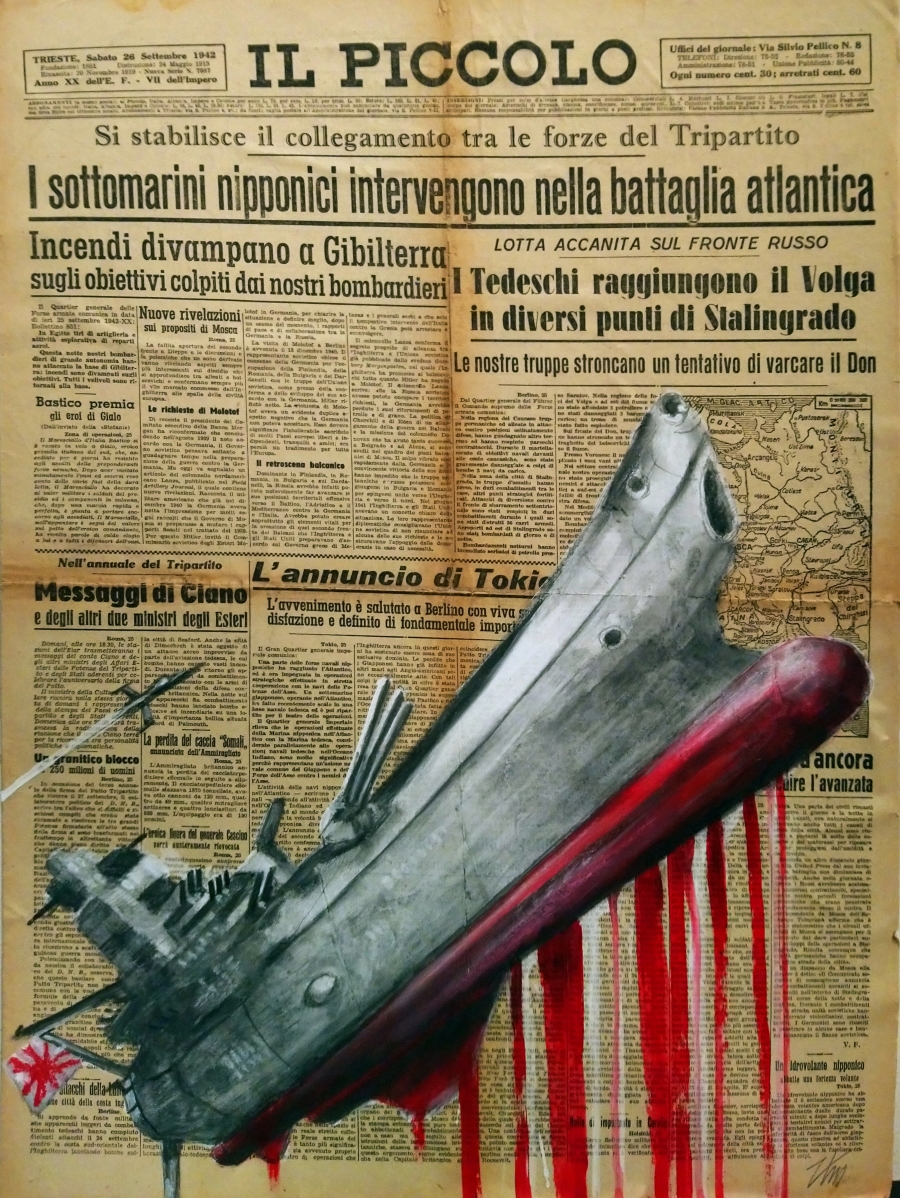
These front pages - drawn from events ranging from the Bolshevik revolution to the Second World War and the Nazi-Fascist illusion of being able to impose a new order even with defeat at the door, moving on to reconstruction and the economic boom, and closing with the Sixties and two mutually antithetical and contradictory examples such as the space adventure and the senseless, tragic Vietnam war, destined to leave a negative mark on a generation - are framed, but not before being painted over with disconcerting icons.
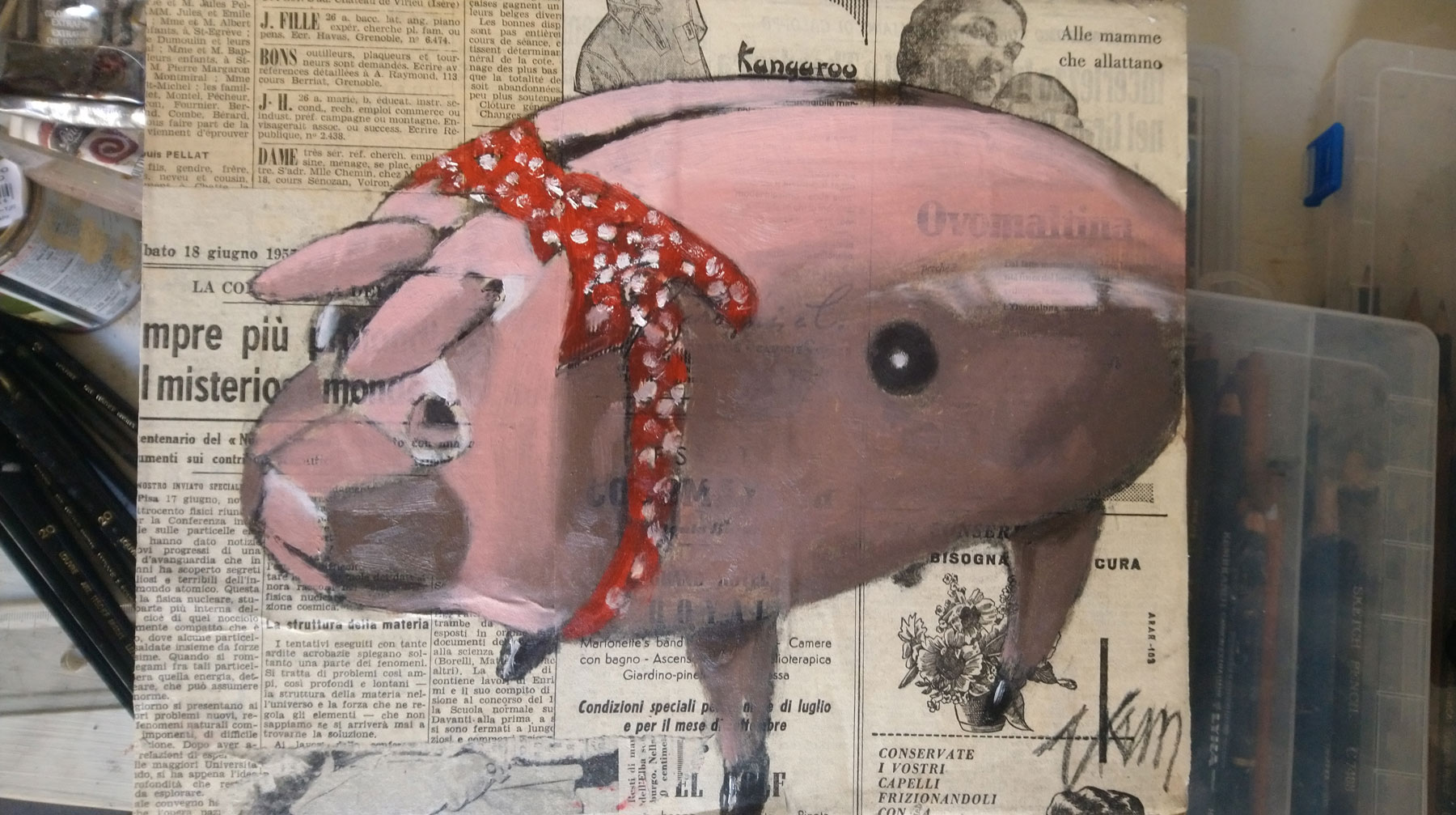
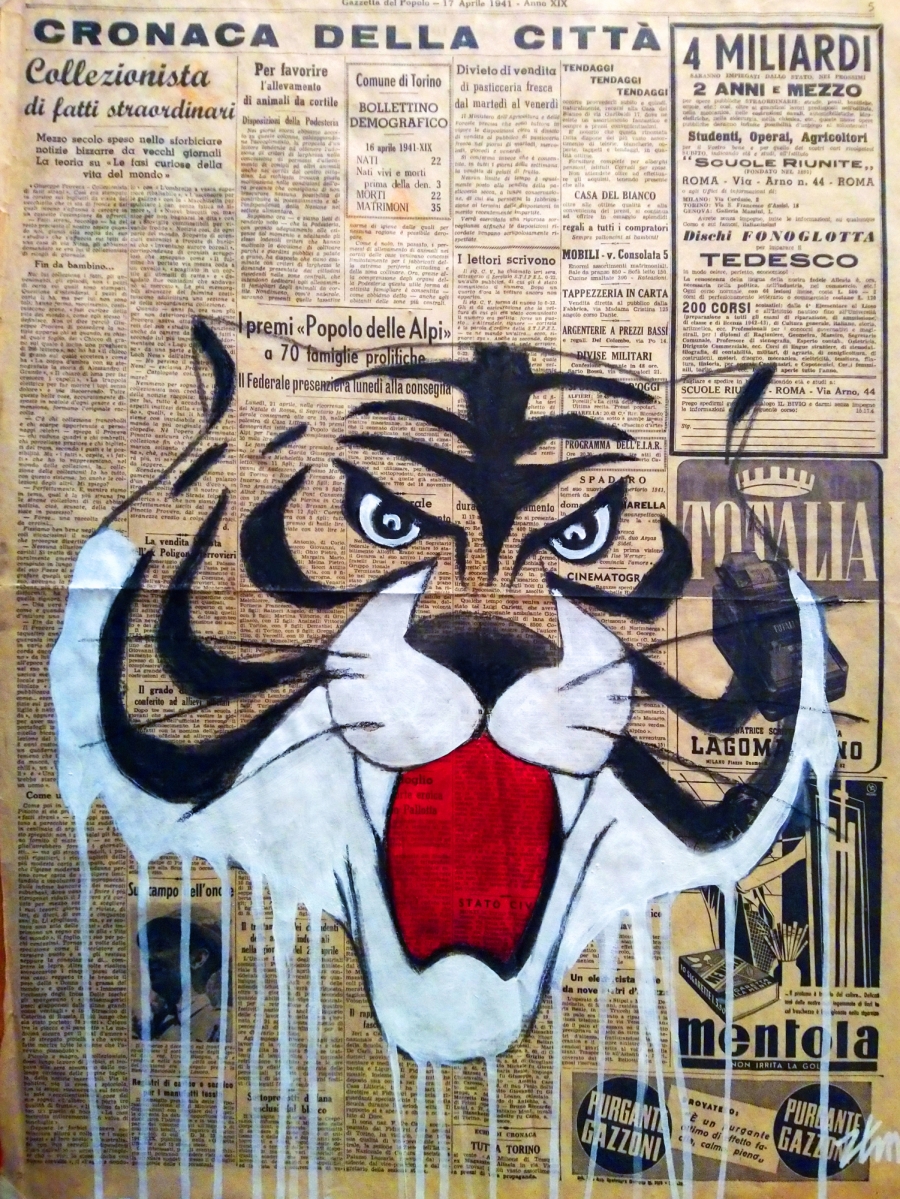
These icons represent figures of the artistic imagination, Botticelli's Venus; of culture, referring to the historical avant-gardes, the great poet Mayakovsky; of comics and of video games of yesteryear, such as the Japanese robots, Super Mario, Tiger Mask; of space exploration, Gagarin; of cinema, Apocalypse Now, and others besides. They establish a metaphorical connection with the printed page, in tune with the knowing interplay between the various and always interconnected levels of memory, image and communication that underlies the original work of Akira Zakamoto.
Introduction by Edoardo Di Mauro to the catalogue of the MEDIAMENTE FALSO project
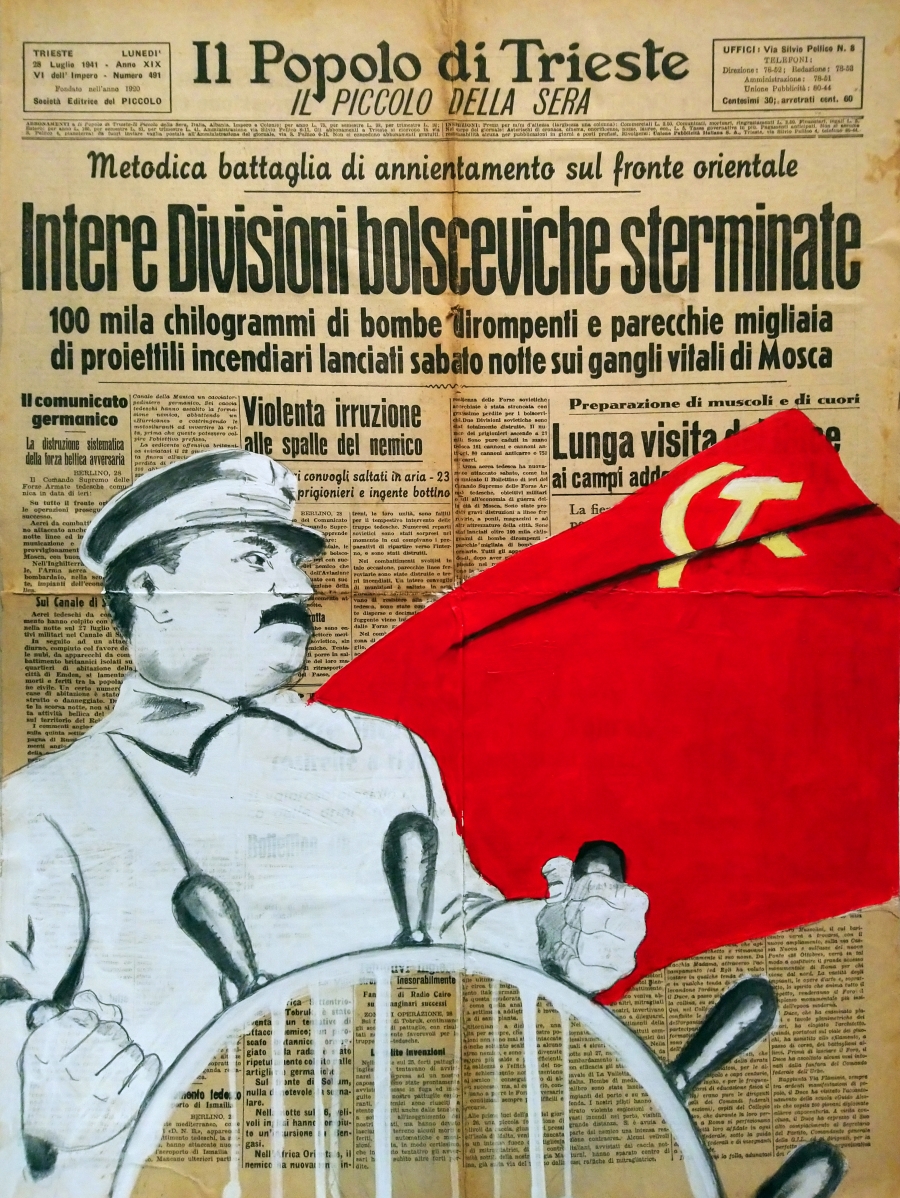 28-07-1941 THE GREAT HELMSMAN - Oil on period newspaper - 45 x 60 cm.
 "Tearing up a daily newspaper is the only way to free oneself, at a stroke, from thieves, murderers, swindlers, apostles and catastrophes"… This quotation from the poet Guido Ceronetti fits Zakamoto's works perfectly: he manages to transform dramatic headlines, generally set in huge type, into visions full of humour, capable of drawing a smile from us and at times a real laugh. By using newspapers as the material for his work, Zakamoto places himself within a long artistic tradition, for the art world has always had a very close, almost intimate relationship with the printed press. Newspapers have been used as a means of communicating artistic ideals (we shall confine ourselves to citing the Futurist Manifesto published in Le Figaro of 20 February 1909), or else as a source for creating genuine works of art: it would be enough to mention Andy Warhol with his "Death and Disaster" series (such as "129 Die in Jet", inspired by the front page of the New York Mirror of 4 June 1962).
There is something fascinating about a newspaper. It is obviously a mass product, born to have a short existence. In the case of a daily (the format favoured by Zakamoto) it is usually printed at night, so as to be ready at dawn to be read by the last night owls and the first commuters. Once, when television news was less pervasive - to say nothing of news through other technological contrivances - there were also afternoon and evening editions, making it possible to follow the latest developments almost in real time. Generally, after a few hours, the newspaper lost its usefulness and suddenly changed function: a hat for the bricklayer, a little boat for playing in the fountain with the children, or more prosaically a wrapper for fish, when it was not simply thrown away.
This has always been the fate of newspapers, but there are exceptions. Despite the fragility of the paper - particularly that of newspapers published during the world wars - even today one still finds here and there, in flea markets, in attics, at the back of a wardrobe, newspapers from thirty, fifty, a hundred years ago. And every such find is a small thrill, and holds a mystery within it. Why was one particular newspaper kept and set aside? Generally these "rediscovered" newspapers are connected to some event considered at the time to be "historic", rightly or wrongly; an event that may also belong to the private sphere. Often, within families, newspapers carrying the obituary of a family member were kept as testimony for future generations, especially in wartime. The page of the newspaper was cut out, or marked with a firm stroke of the pen, and the newspaper turned into a relic.
Then there are public events. Here too, the death of important or simply famous figures is generally a reason for keeping the newspaper. Paradoxically, one might almost write that the newspaper (out)lives thanks to the death of a famous figure, be it a pope (given the quantity of newspapers relating to the deaths of the various twentieth-century popes that I have come across in my career as a collector, I would say that keeping these papers was a well-established tradition in Italy), a king, or an artist, from Giuseppe Verdi to John Lennon. And then of course there are the disasters, whether the Vajont dam or the attacks of 11 September, one of the last events of an era in which the printed press could still compete with television and the power of the internet.
Current affairs, fortunately, are not made only of the deaths of prominent figures and terrible disasters. To make up for days of "flat calm", and somehow to maintain the paper's sales, the editor has to rack his brains to find the right headline, running across several columns, convincing the reader of the importance of the event (and of the need to buy the paper). And so the slightest ambush between soldiers is transformed into a thunderous battle between armies, and the statement of whichever politician takes on worldwide significance… These pompous speeches and these battles would today be forgotten by everyone (except by collectors, ça va sans dire), but fortunately the most improbable banner headlines are the ones Zakamoto prefers. So: thanks to the artist for giving a second life to so much news and so many newspapers - by tearing them to pieces!
Introduction by F-Xavier Bernard to the catalogue of the MEDIAMENTE FALSO project.
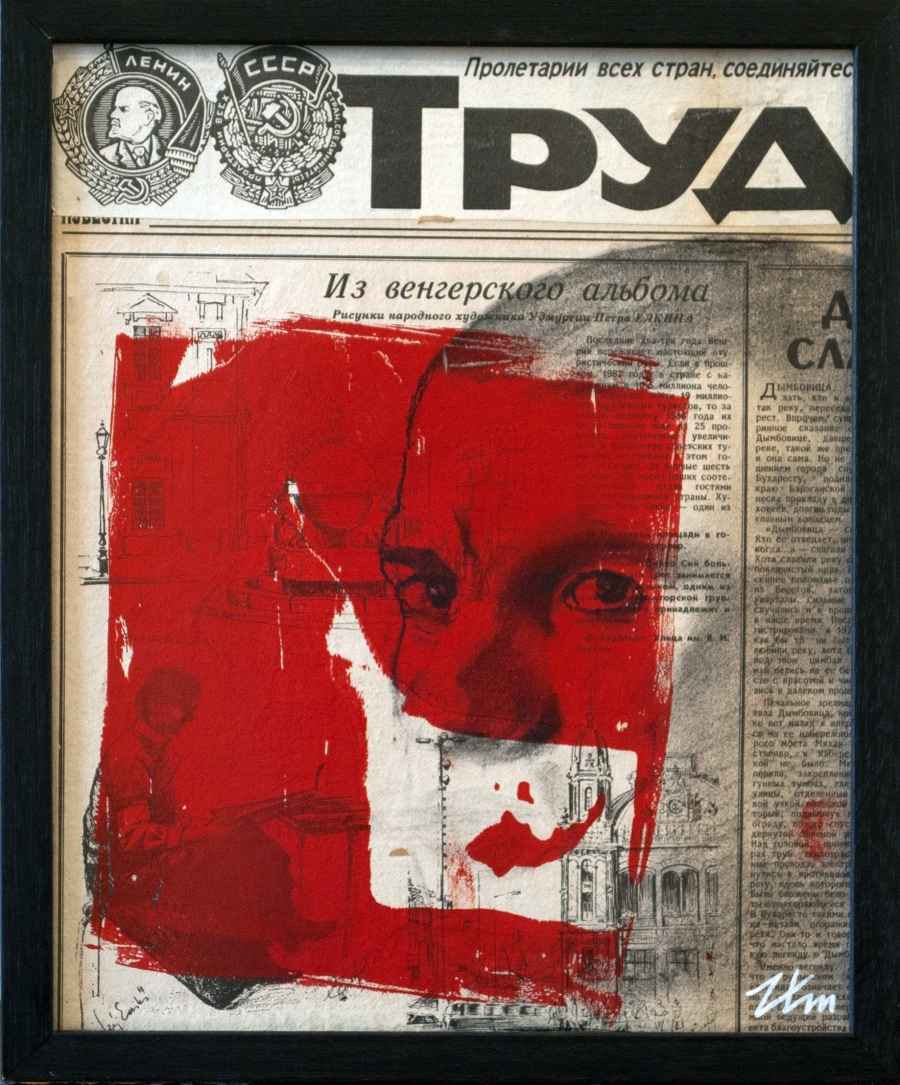 TO MY BELOVED SELF NO. 2 - Oil on period newspaper - 25 x 30 cm.
 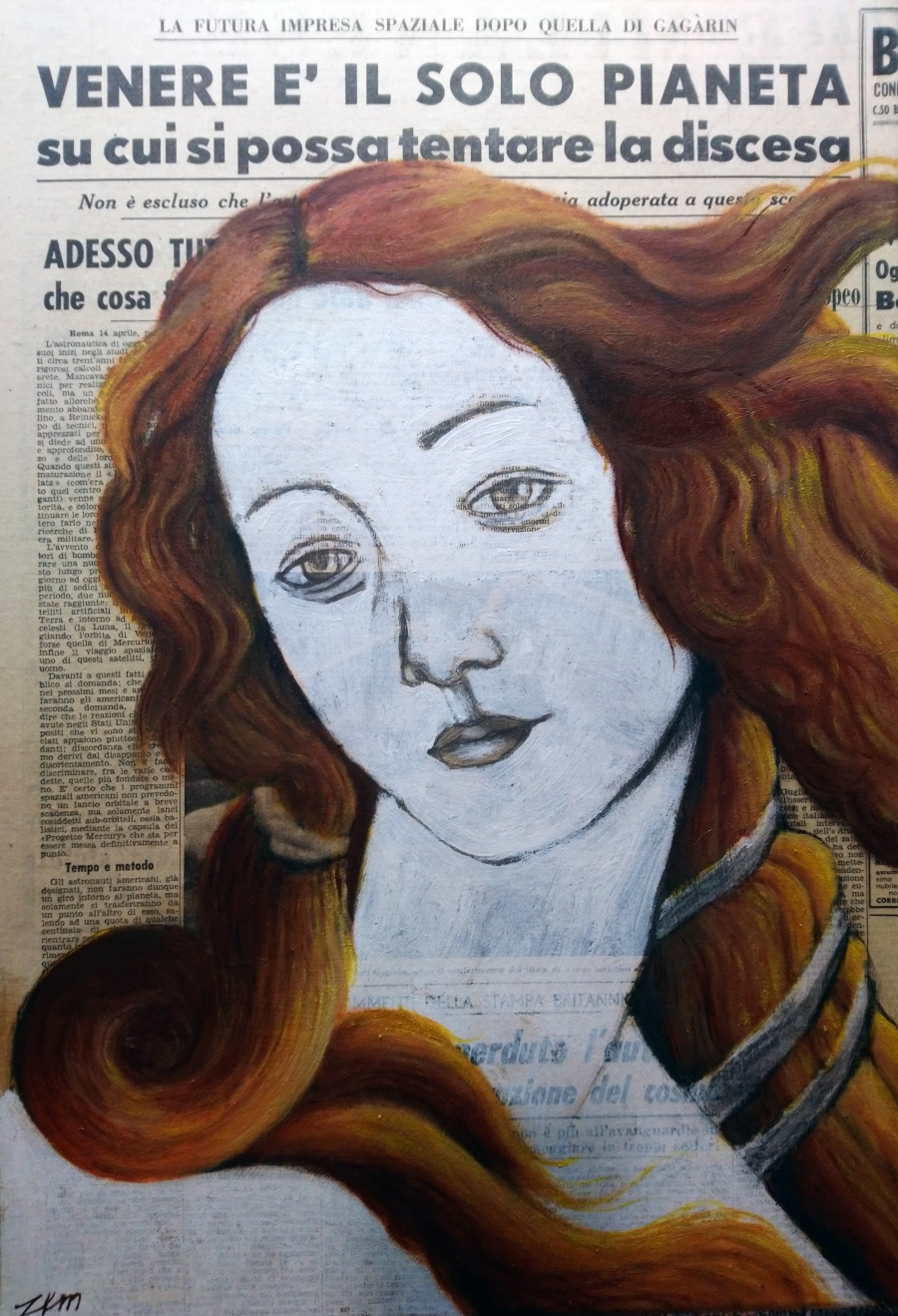 VENUS - Oil on period newspaper 30 x 45 cm. Akira Zakamoto
 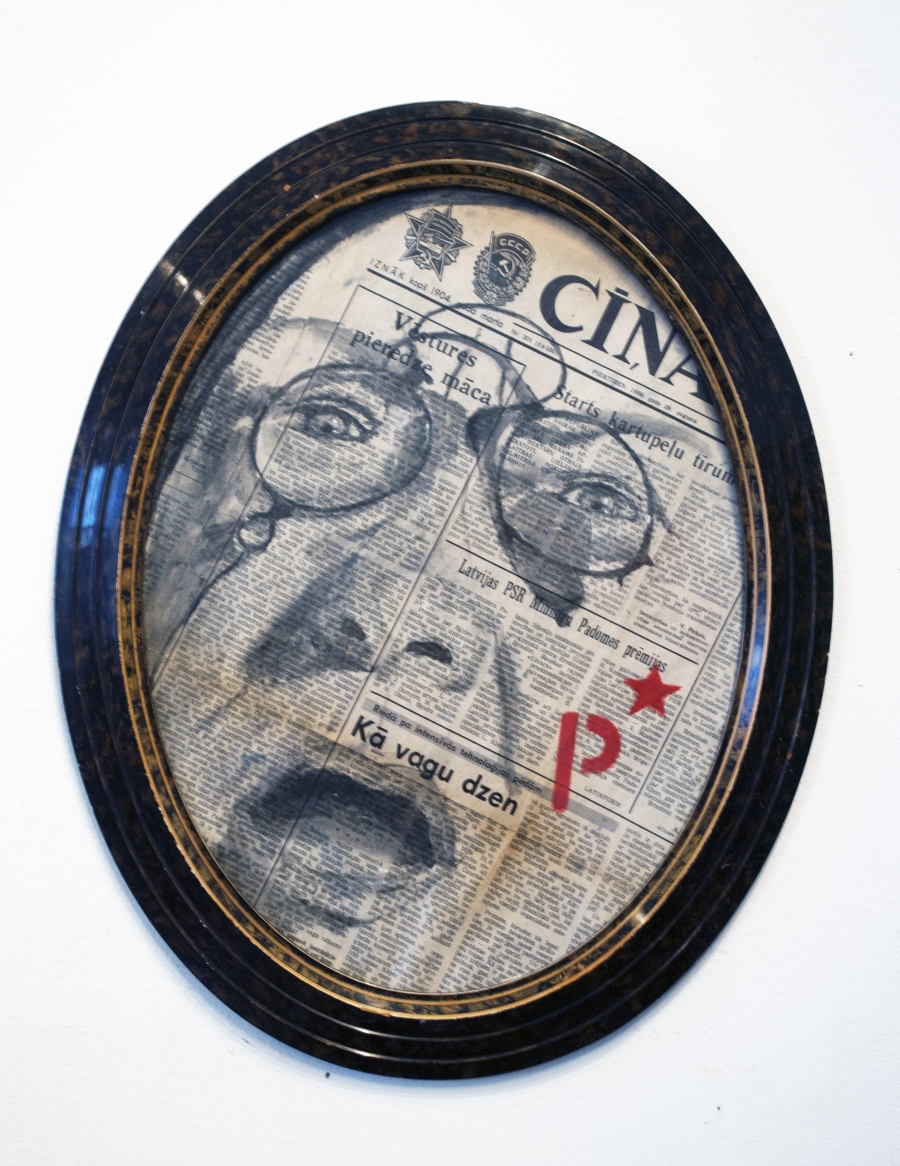 POTËMKIN - Oil on period newspaper 40 x 50 cm. Akira Zakamoto
  MAJIN ZKM - Oil on period newspaper 60 x 80 cm. Akira Zakamoto