Poetry, painting, cinema. In themselves they are today expressive forms reduced to after-work hours. People spend their time producing and pursuing their delirious representations, within a wrong, hypocritical and violent knowledge. Luca Motolese's oblique gaze goes beyond belonging and identification. The artist of the present is always also, a little, the artist of the future, not yet fully recognised. The artist reduced to essence, a poor one perhaps, like those without spirit, heart or money. And so I find a poem dedicated to me. Perhaps because I too am one of those poor.
It is in fact from my shack that I write this preface. From the zone where words are flatus vocis, with no transforming power left. Luca Motolese, my namesake, represents in some limping, slightly anacoluthic way an alter ego. And at a stretch there is room for an antagonistic representation, a visual conflagration, over the film frames of a painter, an exponent of Italian pop art: Mario Schifano. I remember his film "Umano non umano" well. I came across it during one of my various periods of obsession with Carmelo Bene, a figure who anticipated this non-belonging to the arts, with his theorising of a cinema that cannot be made with cinema, a theatre that cannot be made with theatre, a painting that cannot be made with painting, and so on for all the arts.
The end is no longer painting, nor even poetry. It is rather a deaf parrhesia, in the mad need to resolve this reality, this limping will, which dissolves into the vulgar representations of an ignorant but powerful daily life. Oppressions and bombardments, where not material, suffered within a fate that day after day we do not choose but which traps us. So that we find ourselves surrounded by those figures Luca Motolese calls the "retarded". Who are often the very ones who decide who must wear that stigma, for not conforming to the anguished sand of uselessness to which everyone adapts at every moment. This is why Luca says that we "play". Because that is what art is. Venting that immense bitterness on an imaginary plane, while at every blessed moment we are crushed by the indifference of those who can no longer even grasp our words. The weapon of the stupid has become the impossibility of even being offended any more - hence the "retarded". By now beyond recovery, they put us in their place, because we ask to be there. In the place that common sense would assign to them. That of the island outside the human. And instead there they are: it is precisely they who are the humans. That beyond sought by Nietzsche becomes the place of marginalisation, of the squint of those who no longer know which direction is which. Carmelo Bene called them zombies. And so on, in a river of contempt that is the only joy of anyone who feels the chains, for one reason or another.
And yet that paternal teaching becomes at once so Christian and so Nietzschean when our man tells his son: "hate the stupid, help the weak". Often the mechanism becomes even more tangled when one understands that some of these stupid people are also weak, being incapable of disobedience, confined to their role, their security, which makes them incapable of understanding. Threatened by those needs that come from below, from those who speak words that cannot be accepted, because they are too true.
Fathers who teach their children to disobey: the hardest of all disciplines.
It even recalls Angiolieri, when he finds his personification in the hurricane.
"Hurricane Zakamoto has passed through!"
It destroyed everything, even the houses of the wicked.
It weakened the stupid and stupefied the weak.
It found flaws, regrets, evil, ignorance,
and not one drop of hope.
That desire for catastrophe which glues us to our television sets, between a report on the ground bombardments in Gaza, some accelerated sensationalism about the winds of war in the West - just to reawaken a little military endorphin in the lizard cerebellum - and then a few tremors in the Phlegraean Fields, our only hopes of salvation, as when Motolese's son announces the apocalypse to him. An anxious waiting for catastrophes. And yet the real catastrophe is that, should this apocalypse come about, it would not be an apocatastasis. The luckiest would still have more escape routes, a priority of their own. After all, they have paid, haven't they? To stand in an airport queue half a minute shorter. Yes - the old refrain: who are the real poor? Those who empty their wallets in order to depend on office life, from which to listen to Tananai's second-to-last single and plan the next dull ejaculation inside their wife.
And when all is said and done, when Motolese speaks to us of D'io [a pun: "of the I" and "God"], he reminds us of Levinas declaring that God is the other. And the I too is an other - yes, that was said by that other one. The key lies precisely there. Something that does not belong to us, precisely because it belongs to us. We see it, it accompanies us, it guides us, it leads us into temptation, like a devil. The I, and that something belonging to it: hence D'io.
But immersed as we are in dataism, deprived of that unconscious frustration of not belonging to the administrative machine that binds and divides us in an anti-social chain. United by guilt rather than by responsibility. The cold dependency of the quiet life.
Pages full of hope, even if not apparent or banal. As when one wishes eternal life for one's children and not for oneself. Because only a condemned man can love. And that love is at bottom selfish in its self-annulment, because the beloved always makes little of love. They need it in order to live, in order to have meaning, and nothing more. Questions that seem obvious, but which are only brief moments. They cannot last too long. Love is always an instant lasting a few minutes, which seizes us and about which we think for days, for years, for a whole lifetime - but like a faded memory. And so comes the voice of that father whose function is only to remain. To become eternal in the eternity of his children. Something that is an other than himself. Once again in the vicinity of Charleville: a poet who has visions, who dreams, who paints perfectly in the metaphysical style while not being metaphysical at all, while being anti-metaphysical - there where, in the chaos of rage and frustration, there is movement, ardour and confusion. Photons that cannot be gathered by the cornea. Perhaps a few gazes, those of Luca (the other who is me) or that of Annalisa, and I imagine those of many others, like Daniele, Giuseppe, Chiara, Alessandro, Hadil, and many more besides - and in the end a world lit up with gazes before his works. He who does not do painting, because he is an artist. And when you stand beside him, you see in the room a canvas still to be finished. Every so often he sits down and gives it a brushstroke. Incredible, that a seated man can do all this. And inhuman, perhaps, because we have had enough of those noises coming from the street, while the ants stay quiet, by now absorbed into their own metaphysics. It is quite true: Luca Motolese is not a painter but an anti-metaphysical poet. Because to have invested in catastrophe means accepting that tomorrow the strong will always win over the weak, and that we have one great freedom - the Leopardian freedom to dissent from nature, from the filthy planet on which we set our feet, from that ugly power that rules to the common harm, and vanity of vanities: your poverty makes me rich.
Preface by Luca Atzori to the first edition of the book.

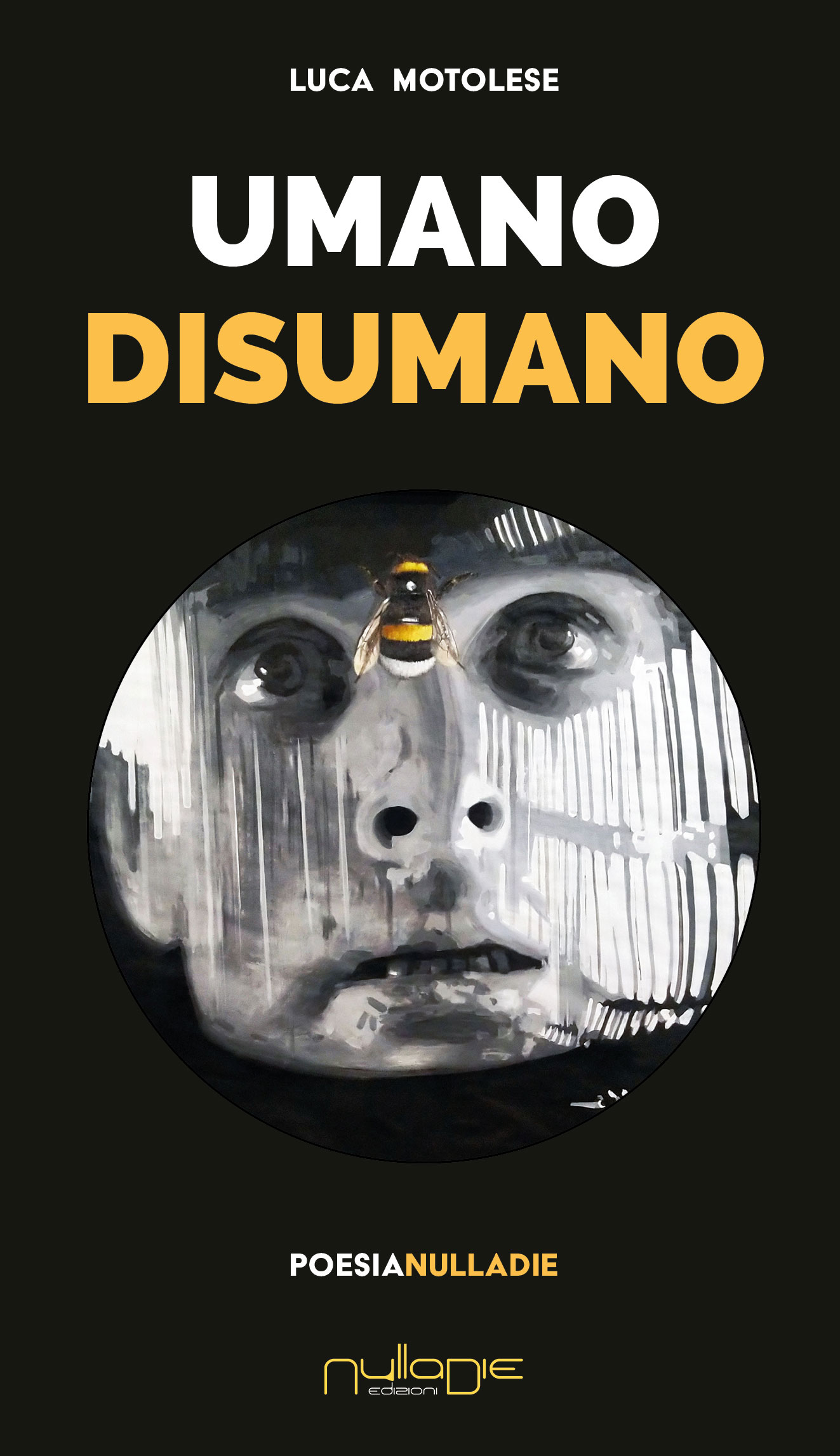 Umano disumano volume I
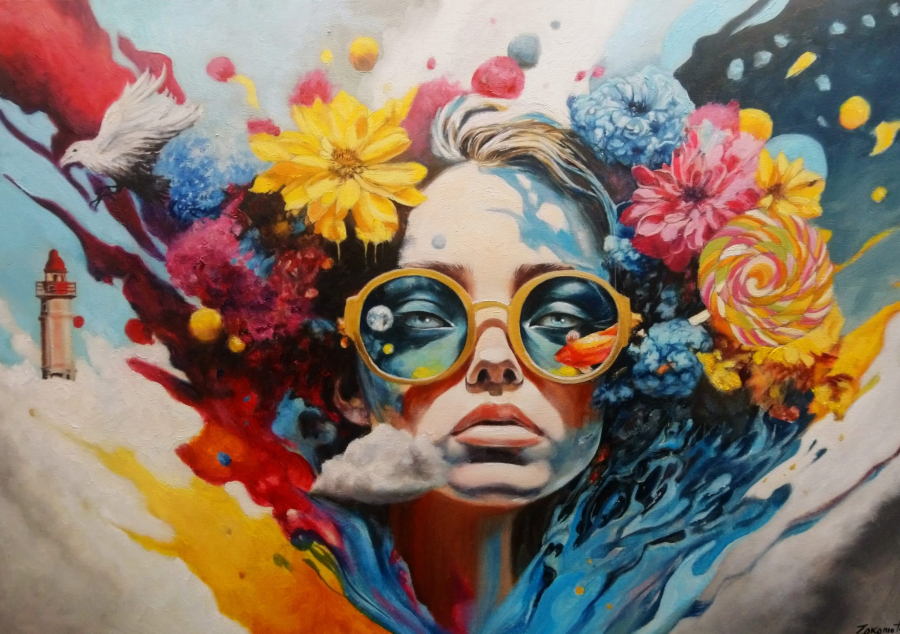
 With the exhibition "Umano Disumano", Akira Zakamoto explores new themes through an unprecedented expressive language. The show focuses on the complex, evolving relationship between the human, the inhuman and nature, addressing the theme of transformation and the poetics of mutation.
The project grows out of the artist's most recent research, gathered in the book "Umano Disumano", in which he investigates the passage from the human towards super-, sub- or trans-human dimensions, proposing a critical vision of the present. In a world where technology yearns for a future of harmony and progress, the artist underlines the contradictions of the present: war, ignorance and environmental devastation. These tensions are reflected in nature's reaction: from being oppressed it rebels, absorbing humanity and its creations into a cycle of destruction and rebirth.
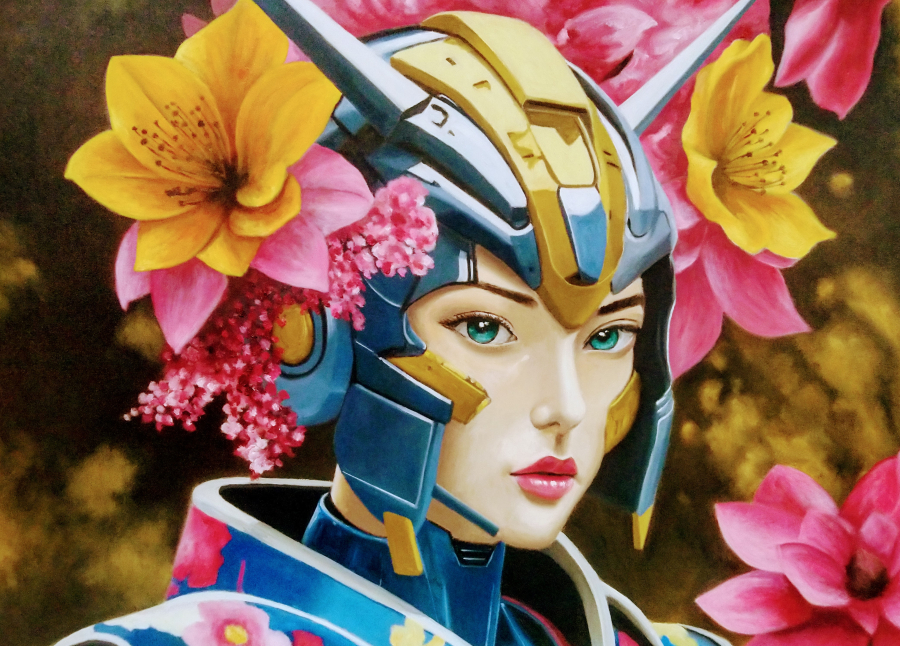
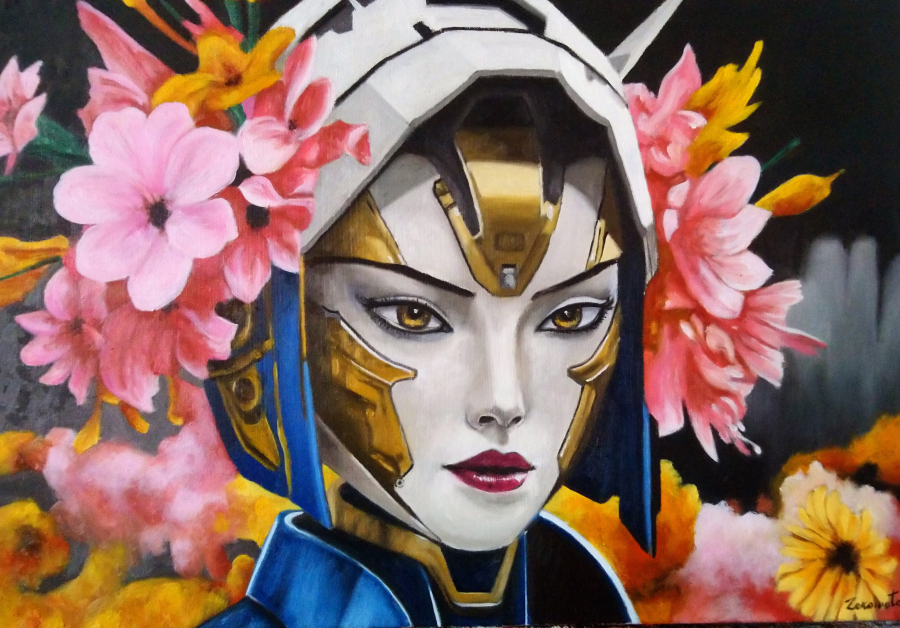
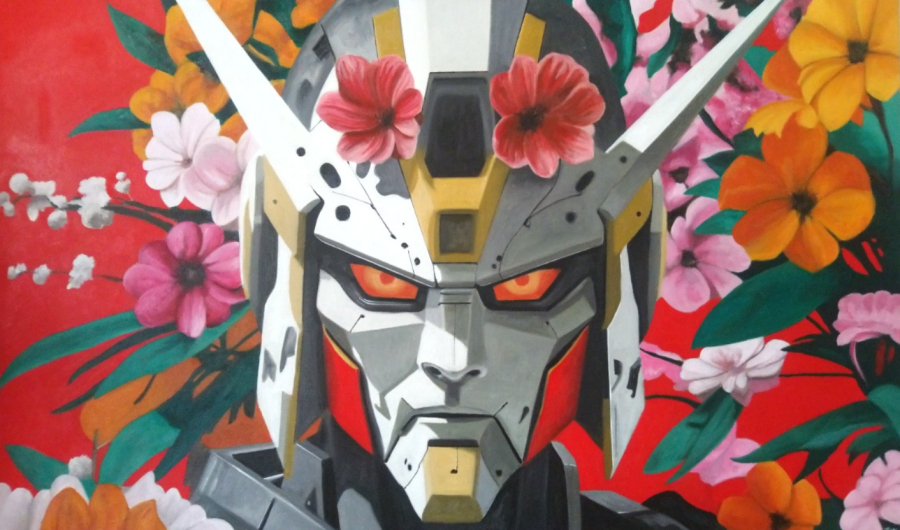
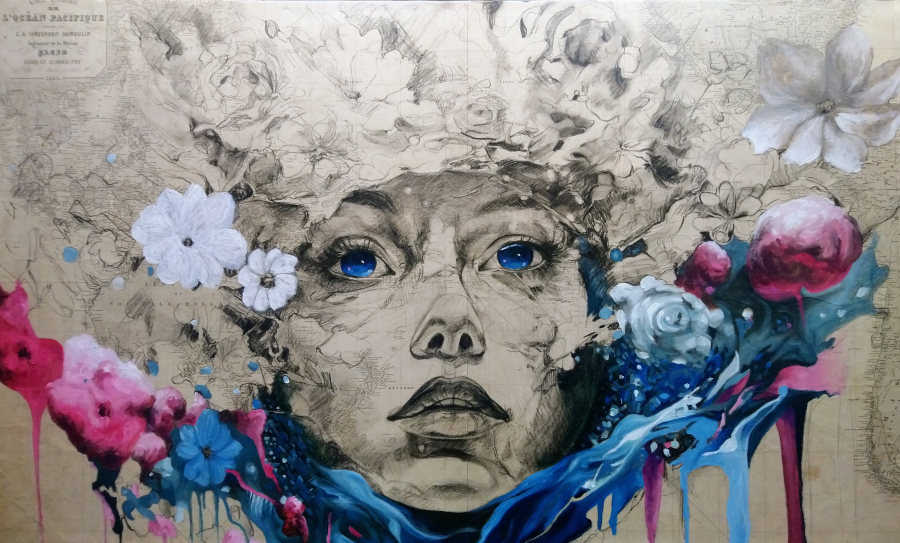
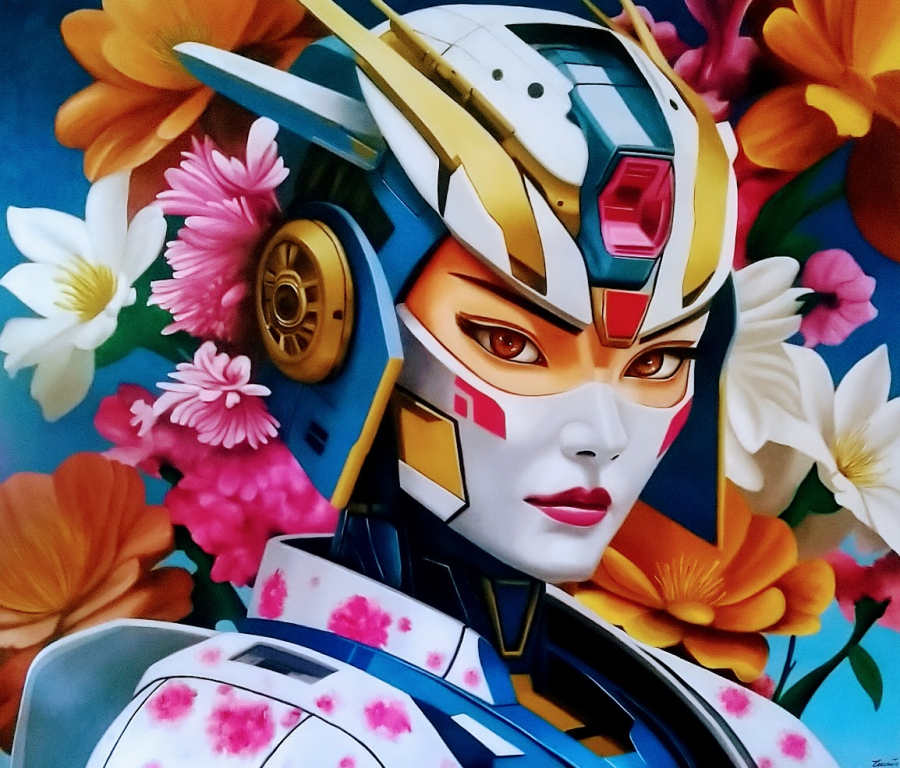
The ten large canvases, imposing in size and chromatic richness, embody a complex and fascinating dialogue between the human world and the natural one, taking their inspiration from the poems that act as a narrative and symbolic subtext. The choice to depict female faces and flowers in forms that oscillate between the figurative and the stylised invites the viewer to explore a layered tale, interweaving themes of transformation, beauty and spiritual connection with nature.
The inclusion of essential oils with floral fragrances is a bold, synaesthetic innovation that expands painting into an experience involving not only sight but also smell, making the works alive and tangible.
Zakamoto's exhibition takes shape as an immersive, layered experience, in which the audience is called upon to identify with a dreamlike video exploring uniform urban landscapes, liminal spaces and metaphysical dimensions. The choice to project the video on a loop creates a fluid, suspended temporality in which the viewer loses all sense of time and finds themselves caught in a shared journey that has neither beginning nor end.
The soundtrack, a central element of the project, amplifies the impact of the images through a hypnotic, recursive rhythm. In it a clear homage emerges to Mario Schifano's feature film "Umano, non umano", a masterpiece of Italian experimental cinema which, with its recurring heartbeat, connected heterogeneous visual fragments. Zakamoto takes up this intuition and reinterprets it, using the sound of the heart as a universal symbol and rhythmic archetype, able to unite apparently alien landscapes and to build a sensory unity that goes beyond the narrative dimension.
At the same time the video recalls Nietzsche's philosophical work "Human, All Too Human", proposing an anti-metaphysical vision that moves away from the romantic and mystical ideal to embrace a rational, disenchanted analysis. Zakamoto places himself in continuity with this reflection, but reformulates it in visual and sonic terms: his liminal spaces are not so much places of transition towards an elsewhere as the symbol of an absence of definitive resolution, a refusal of any system of thought that claims to close the circle.
Zakamoto's research is therefore set in sharp contrast with any cerebral approach that aims to explain the world through logical or metaphysical structures, opposing to it an experience that
feeds on ambiguity, where the journey is not linear and the images become bearers of a multiplicity of meanings.
We may say that this exhibition presents itself as a contemporary manifesto of the anti-metaphysical, able to converse with the avant-gardes of the past without replicating them, translating them instead into a language attuned to the sensibility of our time. The interweaving of the visual, the sonic and the philosophical makes this show not only an artistic event but also a profound aesthetic reflection on our relationship with reality and its boundaries.
Critical text by Marcella Magaletti for the opening in Rome at Atelier Montez, 2024
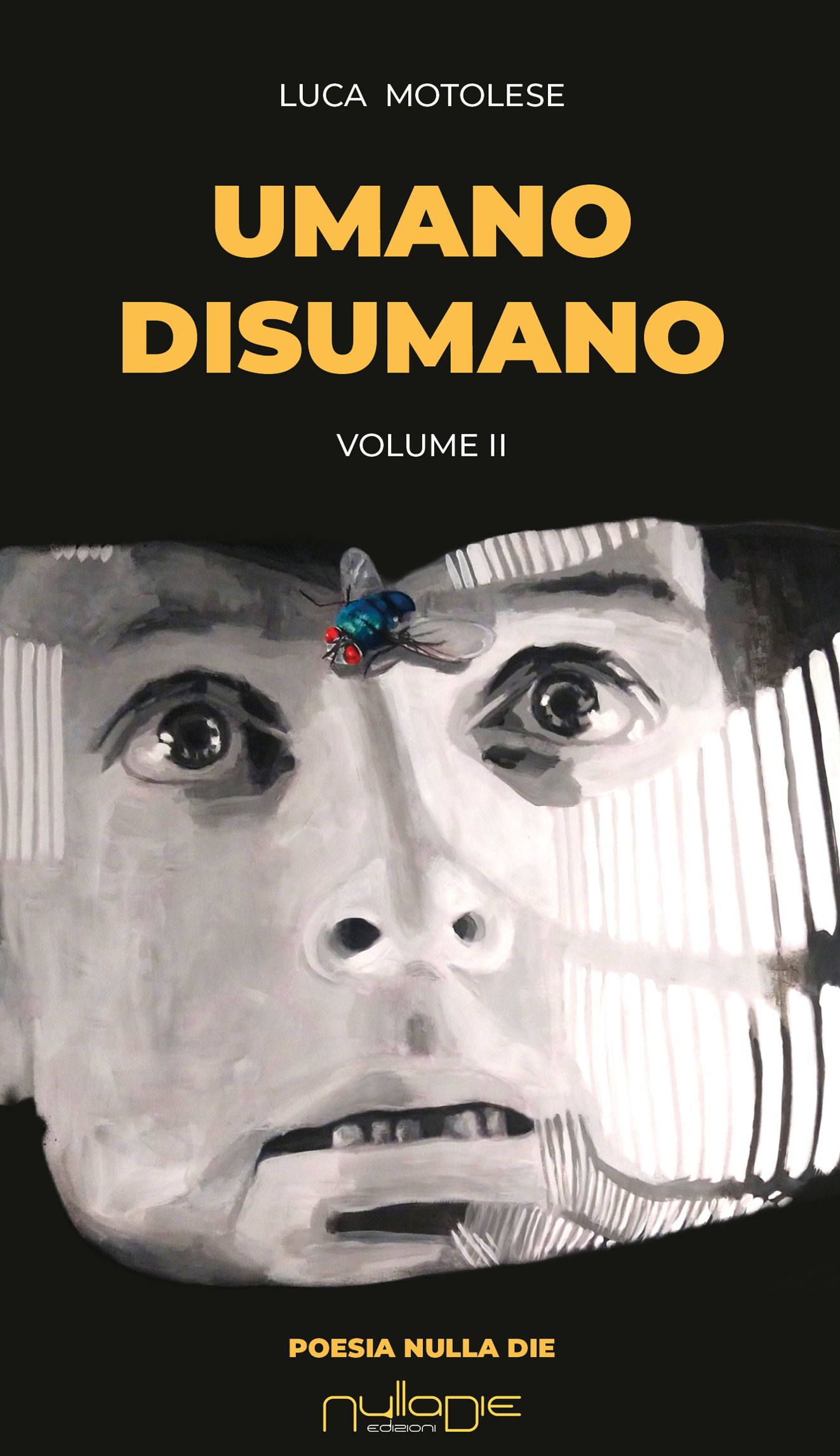 Umano disumano volume II
 To all appearances it was a rocky globe like many others, classified as a planet but too elusive to fall into the orbit of any particular star. It drifted aimlessly, solitary and neglected even by the most tenacious explorers of the galactic empire. Not even in the eyes of the space monkeys did L74M hold the slightest economic appeal, since nothing grew on it but colossal brambles of grey matter, stretching up from the arid surface beyond the boundaries of the ionosphere, as though to shield it from the abuses of the democratic dictatorship.
Had there only been some ocean to make life on it more prosperous, thousands of colonists would have landed like ants to extract nourishment from it, to reshape its coasts and found trading ports from which to draw vast sources of profit until they had drained it dry, as had already happened to the planet Earth. And yet L74M was so bare and so hostile to civilised life that it was left in peace, free of every form of law or government.
In short, no one would ever have suspected that, well hidden in the depths of the planet, a complex labyrinth of luxuriant tunnels and caves lay concealed in the greatest secrecy. Down there grew flowers of colours never seen before, whole green valleys to be crossed on horseback, clouds of cotton and castles of linen, held up by wooden structures but powered by running electric currents, tending towards indigo like the sky of those underground lands, which the Akira called home.
It was a question of isolationism. The desire to be left undisturbed characterised those lands; the dream of quiet ran in the veins of the people of L74M as the lust for power had infected the space monkeys since the dawn of time. Even so, however, given the creative nature of the Akira, it proved impossible to turn their backs on the injustices of the galactic empire.
Here and there across the vastness of the infinite, worlds made war on one another while bureaucratic cobwebs made life impossible for the hungry and easier for the well-fed fascists. So L74M unanimously decreed a compromise with itself: the Akira would send indigo and flowers, cotton, wood and linen out into outer space, mixing them into the already overloaded postal system of the thousand civilised worlds. They really could not let the empire win - nor the space monkeys who toasted after every massacre, at every swindle, for every household appliance consumed by planned obsolescence, and on the highest note of every curse of the repressed working class.
The message would certainly be delivered some centuries late, and the galactic empire would try to erase those traces of divergent thought from its own information system; but somewhere, at least someone would find a treasure on the doormat, in the letterbox, or resting on the windscreen of a car with an empty tank.
And so, for the inhabitants of L74M to feel somehow satisfied with their contribution, it was enough to think of the smile on the faces of the lucky ones who, quietly expecting to pick up a parking fine or a tax demand, would instead think:
Perhaps a better world exists.
Introduction by Mattia Motolese to Volume II
SILENCE
In my studio there is never silence
even when I switch off the music
there is always a background whistle
the dull noise of the multitude
the cosmic noise of the city
At night on the boat
when the silence is at its most absolute
I think that perhaps everyone is dead
and I want to go back to shore
to check
"Umano Disumano Vol. 2" is not simply a book. It is an archive of fragments, a collection of details that seem invisible and yet accompany us constantly, drawing a map of existence. Every word is felt as a trace left in the sand, ready to vanish and at the same time able to remain, suspended between the ephemeral and the eternal. Luca guides us through this cataloguing of thoughts and invites us to look at the everyday with new eyes, making us rediscover the subtle absurdity hidden behind the ordinary.
In every line, in every fragment, we sense the presence of an inventory of the soul. Unspoken thoughts, forgotten objects, faces that slip away: everything is interwoven, creating a mental space in which the real blurs into the surreal. Through this lens his poetics becomes a collection of details that seem small but tell larger stories, suspended between past, present and future, held still in a stillness of their own.
Moving between the lines is like walking through an infinite city, a route that escapes linearity. The reader is immersed in a fractal weave of memories and sensations. Luca holds out to us a lens capable of revealing the hidden spaces between one thought and the next - those fine cracks through which a reflection on the human and the inhuman looks out. And so each fragment joins the others to create a possible story of ourselves and of what we might become.
But beyond this surgical cataloguing of life, a disquiet emerges, a restless soul. "Umano Disumano" leaves us suspended on the threshold of the indecipherable, pushing us to reflect on the very nature of humanity. And it invites us to ask ourselves what it really means to be alive in a world that seems ever further from itself.
This poetry, with its oscillation between irony and tragedy, becomes an archive of existence, a map of the spaces between things. Luca's pages lead us into a labyrinth made of everyday epiphanies, where sensations and parallel visions are revealed little by little. His aim is not to explain the world but to make it visible through details that remain suspended, floating in the air, as though waiting to be picked up.
There are no easy answers in these pages. The book pushes us to ask what is left of us, of what it means to be human in an age that seems to have lost the sense of the essential. It leaves us the task of becoming archivists of our own bewilderment, gathering the fragments of a shattered world in an attempt to find a new coherence.
In the end one question remains, and it concerns us all: what does it mean to exist in a world where shadows and lights merge with such ease?
Introduction by Riccardo Mantelli to Volume II
NAKED
Naked
I look towards the future
from the window of my studio
A labyrinth of saturated colours
Melancholies and absurd hues
The cube comes together
and falls apart
at the same time
Motionless frozen desert
A flower between your thighs
From the empty rooms
we look outside
alone and naked
I have already seen this future
a thousand times
always the same
Final level
Game over
Friendship. When a friend of yours, who is also one of your favourite artists (a painter, or better, a maker of images), asks you to write the preface to his latest book - this Umano Disumano Vol. 2, which came out immediately after Vol. 1, published in the spring of 2024 (with a preface by another mutual friend, Luca Atzori, a theatre performer and a very special poet, certainly a native of some distant galaxy) - you cannot help being happy.
Writing about Luca Motolese, whose artist's name is Akira Zakamoto, born in Turin in 1974, is very complicated, unless one starts precisely from the human being: that Luca whom I have not known for many years, and yet in the end it is rather as if he had always been there with you, one way or another - Luca, your elder brother's legendary friend; Luca, the older cousin who takes you out on a Vespa for the first time (and you are eleven).
Previous prefaces (Vol. 1, L. Atzori). Now, however, a sort of preamble is needed, one that already tastes of a conclusion: our Luca is not an "artist", and this book cannot have been produced by a "poet".
I fully agree with what the aforementioned alien Atzori wrote in introducing the first volume:
Luca Motolese's oblique gaze goes beyond belonging and identification. The artist of the present is always also, a little, the artist of the future, not yet fully recognised. The artist reduced to essence, a poor one perhaps, like those without spirit, heart or money. (…)
The reflection closes with a necessary appeal to the Bard, CB:
(…) Carmelo Bene, a figure who anticipated this "non-belonging" to the arts, with his theorising of a cinema that cannot be made with cinema, a theatre that cannot be made with theatre, a painting that cannot be made with painting (…).
Friedrich Wilhelm Nietzsche: placing oneself in "listening", the eternal twenty-year-old. The second volume opens with at least one quotation from Friedrich Wilhelm Nietzsche's Zarathustra - the philosopher of the impossible, perhaps the most beloved of our late adolescence, together of course with Hermann Hesse, before that strange flush descends on our cheeks, overcome by a sense of shame typical of those who want to forget how educational those first moments of eroticism and self-eroticism really were, shut away in one's little room.
Nietzsche, who is not a philosopher but writes the greatest literature; who for men of letters does not write poetry, but is a magnificent philosopher. He is, moreover, a classical philologist, and for some years works as a university lecturer, before discovering the Wagnerian wind, or fire. The boy from Röcken has, over time, become a kind of toyboy of middle-to-high culture; he is two thousand five hundred years old, but he will forever remain a disquieting twenty-year-old full of dreams.
After all, philosophy too cannot be done with philosophy. This is not a discourse about interdisciplinarity in the age of globalisation - no, something deeper and more elusive is at stake here (and the discourse on Post-Modernism no longer makes sense either, made today, in 2024).
Quite simply, what Nietzsche does is always to place himself in "listening" with respect to the things of the world, visible and invisible; and in his own way that is what our Luca Motolese does.
Openings, before and after. During the opening of one of his recent exhibitions, Luca avoids talking about "technique" with those who approach him. Starting from someone else's reference to a detail found or discovered that might be connected to another detail, and then to another, endlessly, until one arrives at such-and-such a painter of 1976, with respect to his exhibited work (Porco Nero, for instance), Akira-Luca intervenes as little as possible. Do you know him? Did he inspire you? Did you see him on social media, by any chance? It is certainly something to do with the collective unconscious. While the improvised expert lays out his cards, Motolese is ready to take everything from him - he could suck out his very soul - and within a very short time absorb him into a work of his own, whether visual or written.
The evenings after the presentations are then an invitation to Dionysus, to life and to healthy confusion. In no particular order, the talk turns to rock music, comics and manga, the Peloponnesian wars, friendship, post-feminism and robots, planispheres, parents, the songs of Piero Ciampi, a Fassbinder film, retro-gaming and new video games, the destruction of Gaza, pandemics and restrictions, children, loves and motorcycle journeys, the first technological invention in history (the wheel?), Carlito Tevez, and the African queen Nzinga of Ndongo and Matamba.
Shall we talk about Vol. 2? But we were already doing so… In this splendid and mysterious book too, Umano Disumano Vol. 2, situations emerge that make up the puzzle of life, of every possible life. To place oneself in "listening" means at the same time to be in perpetual "critical detachment". Nothing is fully satisfying in our contemporary society; Motolese's "non-poems" - let us simply call them "thoughts" or "fragments" - lack a "definitive form" (the same goes for his paintings, which cannot be catalogued and live in a continuous vortex of movement). Does fixing a "style" of writing or of painting go against the attitude of "openness", of "listening" and of "critical distance"? Probably yes.
Human, All Too Human and Umano Disumano: let us not fall into the little game of comparison and influence. Motolese-Zakamoto does not quote or take up any famous text of the past; what is involved here is a shared attitude.
Meanwhile, let us pull a great art critic out of the hat.
This is what Edoardo Di Mauro wrote about him in a catalogue for a Turin exhibition of 2023, entitled Media-Mente Falso:
(…) he has the capacity to land hard blows on the hypocrisy of the society of spectacle and image that characterises our present dimension, employing signs, symbols and "vintage" inserts.
Collage and contrasts are scattered more or less everywhere in these written pieces too; for instance in the sixth fragment, entitled In trattoria, in which the "retarded" return to the fore (see Vol. 1), their backsides resting on a cushion of Mongolian sheep's wool - and the footnote on the word in question, today condemned as "politically incorrect", opens the field to combat by way of social satire (Motolese's very personal definition of "progress" is most interesting). In other texts we find these "retarded" once more, incapable of seeing the new risks of commodification, of consumerism, of control: it is called, once again, "capitalism", the same damned monster, always the same one. The "wicked" are named, by surname - puppets in their turn of a system, as in the highly entertaining text Pandemonium girotondo scientista.
The moving homage to a new love, the reflections on his own family, the references to things that happened with lifelong friends, the presence of the sea, are sudden pauses of silence within the chaos of our society; but the fear that they might be ruined by the world of the "retarded", or at least contaminated by it, is very strong (are love, family and friendship not, in the end, social conventions created by that same democratic-capitalist society?).
Stop! Conclusion! One could go on much longer, but what would be the point: let us enjoy this book, let us run to see his paintings; we shall come out of it more confused, and certainly better and happier.
Introduction by Daniele Isabella to Volume II
REGIONAL
A regional train
with phosphorescent green doors
and Bulgarian stripes down the side
powder blue and acid yellow
dirty blue curtains
framing jammed windows
plastic heat-pressed seats
decorated with end-of-millennium textures
Everything recalled
the social-futurist taste
of the glorious time gone by
of the country that was the locomotive of the world
and of magical nights chasing a goal
After Umano Disumano vol. I, I became convinced that a prologue like this was needed, in the omniscient universal first person singular. Yes, it is urgent! I have convinced myself of it. I am writing it with my left hand because my right one still hurts.
It took a bad knock. A trauma struck it when, over there in the goatish vineyard, celebrating, I slipped into a hidden ravine. With the global warming I have arrived at in this ill-omened inferno, among tortured burning lips and sexless dancers on heat, it is absolutely indispensable that I depart to reach unexplored peaks of by-now-thawed, practically non-existent glaciers; to press my boot into the muddy ground among millions of fossils of millions of years and of boiling waters that have finally begun to flow again in a descending motion, granting new depths to the abyss.
I write with my left hand because the right one is busy accelerating along the tortuous paths of religious monks who emerge and thus come to the surface around the naked mountain. And between one peak and another, high up, the tightrope walker's rope stands taut and suspended, so that should the need arise we might find ourselves up there on the mountain celebrating existence, united only by the solitude of being alone. Virtuous me, writing with my left hand in order to alter my handwriting and confuse the stream of consciousness, so that on rereading myself it will seem to me that it was all written by somebody else - even though in the end it will all have been typed out and there will be nothing left to read.
Leftwards I also swing my sense of guilt, which will not let me laugh at myself and make fun of that retarded person I am, and always have been. Indeed, I have only now understood that the Japanese have no sense of humour, and that to play you need at least two people. Topologically one must think that a mountain with a peak must also have a valley; or that there must be at least one other, a woman; and that the woman has at least two peaks besides the valley! And so on and so forth… To get over this tragic fall into the swamp of fossils and mud, one must learn to ruin it off. I meant to write laugh it off, but ruin it off might do just as well.
One must get high - no, get children - and let them play together, letting them inhabit the thawed peaks and letting them piss down on the heads of the much-praised retarded. With disenchantment and lightness, the children will inhabit those places where everything is sacred and where the most sacred text preserved is a practical manual entitled "how to fart without shitting yourself". So I shall see you up there on the child-mountain, to make lofty fun of those retarded people who push a motorbike in a straight horizontal line while making the wheels turn round backwards. Those left behind are frenzied progressives defeated by inertia, racing at photonic speed in a straight line as rocket-missiles do, never changing trajectory except when they buckle, crushed by the weight of the atmosphere, completing seven and a half circuits of the globe per second only to return always and forever to the same moment in which they accelerated in order to move away from it.
And then I am sure that sooner or later the retarded one will ask himself whether pushing the motorbike causes the delay, or whether it is because I am retarded that I push the motorbike. Who knows. Luckily there is always something to learn and to take as an example. Motolese's legendary motorbike, for instance, is different from the others if you look closely. Highly evolved futuristic bio-mechanical technology forbidden to anyone over 6, with a tiny Lilliputian-sized fairing and little atomic buttons like those of the StarTAC, the mobile phone with which it is impossible to decide which number to dial. I am quite certain it is a technology produced in that place some people call "Japan", where the irony of fate decreed that it be used to learn how to make prank calls; and I am also sure that it dates from the post-imperialist era, at least thirty years after General Nogi's famous hara-kiri, at the time of the economic boom that sprang from the destruction of Phoenix.
In short, this technology paradoxically starts up at the press of a single button. Pul. Zak Zak Tumb Tumb. And off it goes. Started first time, it turns into a rocket-missile that streaks upwards between the peaks, then descends a little, until it strikes Montecitorio. It is said that the lower mountains are sacrificed to the savage ferocity of technology gone mad, while human intelligence will know how to take refuge on far higher peaks. Besides, this motorbike is an entity lacking all initiative, a means like any other, and its attributes depend on the use made of it. In any case, meanwhile, I lean out a little, at least to see whether the rocket-missile worked. It worked. Montecitorio now looks more like a pantheon. The recession advances through woods of outstretched arms, tubes, levers, brakes and clutches; but also thanks to bananas and to rocket-missiles landing on palaces and churches. The world has finally reopened itself to the feminist vision, so that I think I speak for everyone when I say that I too am a bit Giorgia. [an echo of the Italian prime minister's much-parodied "I am Giorgia"]
Yes, that's it! What a fine castle, marcondiron-dirondello! [an Italian children's rhyme] That is why I fret so, said the lady with the trinket. But the principle is always the same: if you know there is something you cannot do, act and avoid speaking about it. And so I have convinced myself that I am convinced I want to create a feminist and evolutionary party of action which we shall call, in chorus, "fallo" [in Italian at once "do it" and "phallus"]. I must always remember to carry a banana with me; or rather, not with me - I shall put it in my clutch bag, which is handier and prettier, for you never know: should they mistake me for a Japanese road pirate, I could always show them this or that evolution, and I would be sure they would recognise me. When I speak of evolution and giraffes, my nerves rise to the surface of my skin. I immediately become a Darwinist; or rather a Darwinian, because I prefer to reason with my backside. If I think that giraffes evolved over time, I lose my temper.
It seems that in the beginning they were a kind of bastard, chance cross between a hinny and a tortoise which - without going into too much detail - would mate, giving rise to a rare species, since almost always sterile, of short-necked Somali giraffe. Creatures more or less mythological, slow, of little use for anything, not even for making stock. They were cruelly mistreated by the colonists who found them in their path after the great horizontal Atlantic crossing to the left. Such animals were good only as beasts of burden, and so the colonists pulled their necks, making them haul great loads of gold, diamonds, incense, myrrh, corncobs and sugar cane right up to the great ships at anchor, and then leaving them ashore, exhausted, since with necks lengthened by all that toil they would not fit in the ship's hold - which is, indeed, a technology certainly conceived in the East.
And so here on the summit of this mountain, while I piss, I contemplate in ecstasy the wonder of the twilight hour, when all creatures seem busy and there is a great movement in the air and the mosquitoes fly among the last lines of sun which, in withdrawing, deepen the half-light where the bats trace circles in circular motion at low altitude, and the woodpecker hurries to deliver its last hammer blows, quickening the drumming rhythm and the war cries of green parrots that flutter among the rocket-missiles - while it is already time to migrate once more towards new horizons. Now, if you are still smiling without knowing why, this is the right spirit in which to approach this marvellous read. You are ready to turn the page.
Introduction by Gio Montez to Volume II
PAINTING OF CHILDREN
As though painted
on the beach
children in love
slept in each other's arms
while the horizon filled
with storm clouds
UMANO DISUMANO - THE JOURNEY
The transition we have been witnessing over the last thirty years - from the human character to the beyond/super/in/sub/trans-human character - has guided my research in this recent period.
In the book Umano Disumano, published by Nulla Die, I have gathered part of this research.
The instruments available to humanity today would suggest a future in which a super-intelligent humanity might live in peace and prosperity; yet, inexplicably, stupidity, war, ignorance and scarcity monopolise the present in all its facets and in every place.
The video explores this theme further through a long, hallucinatory journey and its poetic sound counterpoint, in which the viewer is forced to brood on the insidious question contained in the title: a slow, hypnotic walk filmed from the walker's point of view, seemingly endless in length, through various cities (apparently all built by the same architects, and colonised by the same multinational shops) joined to one another by dimensional tunnels which the protagonist keeps entering.
The soundtrack consists of the thoughts of walking (poems and notes by Luca Atzori and Luca Motolese).
Robots in love
Zakamoto's series of robots in love was born from the contemplation of the contemporary human heart: apparently arid, extinguished and anaesthetised, a heart in which feelings seem no longer to find room (nor citizenship).
Within the human-inhuman frame presented in the books and in the video, the artist too no longer has traditional instruments at his disposal, and finds himself "playing" with representation as a form of survival. The robots in love are silent witnesses to today's human condition, redefining the very concept of "feeling". Their loving gaze becomes critique, proposal, dream - perhaps the only impulse towards something still authentically alive.
Human beings prefer to present themselves stripped of the feelings they cannot help having, believing that this stratagem frees them from the risk of suffering; robots prefer to present themselves with the feelings they do not have, trying to simulate the language of falling in love and of joy in order to appear more like human beings.
A robot with shining eyes only wants to convince us that it feels love - but then, even with human beings, we never know what they are really feeling: we can only interpret the signs.
The theatre of this tension between robots with feignedly loving eyes and humans feigning aridity makes one imagine how the heart missing from so many bodies, the renunciation of feeling, leaves robots as the last guardians of humanity.
The sound of the metal kept the steady rhythm of what had once been a human heart.